
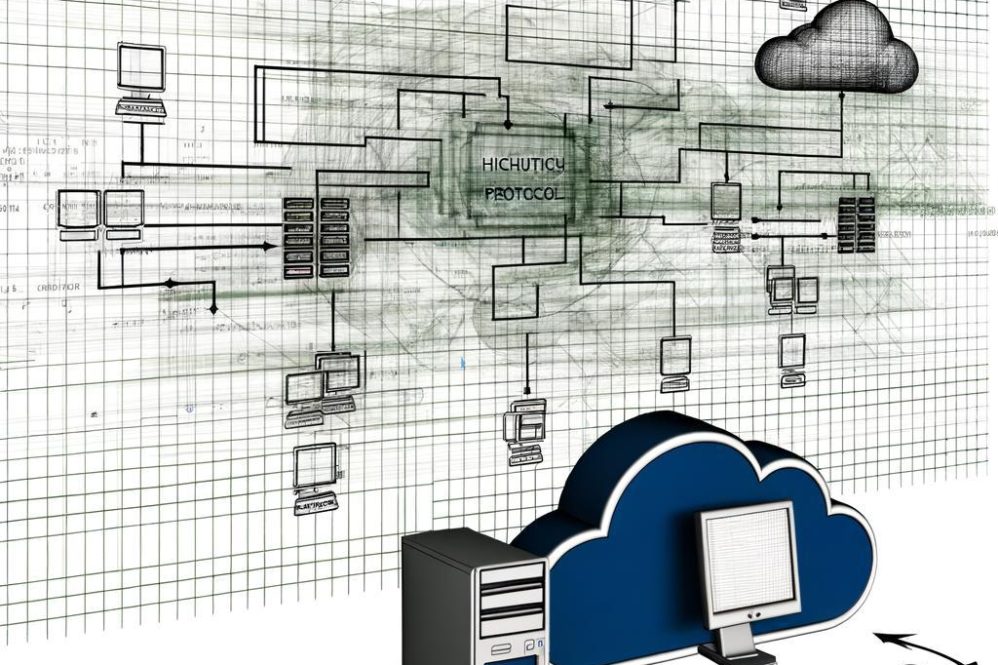
Architectural Overview of the Nostr Protocol Client: Distributed Relay Topology, Message Flow, and Performance Trade-offs
In typical deployments a client maintains simultaneous connections to a set of independent relays, creating a logical overlay that emphasizes availability and redundancy rather than strict peer-to-peer consensus. Each relay functions as a stateless or state-light message forwarder and indexer: clients sign and publish events locally, then push those events to multiple relays to increase probability of discovery and persistence. The topology therefore favors fan‑out writes and fan‑in reads, with the client acting as the locus of trust and identity: cryptographic keys are generated and held client-side while relays are treated as replication and discovery endpoints rather than authoritative authorities.
Message flow within this architecture follows a small set of well‑defined primitives that shape concurrency and fault tolerance. A client typically performs the following actions:
- Event creation and signing (client-side cryptographic integrity),
- Publish to multiple relays (wriet replication),
- Subscribe with filters (selective read and streaming delivery),
- Local deduplication and caching (reduce redundant work and provide optimistic UI),
- Reactive backpressure handling (rate limiting and reconnection strategies).
Concurrency is managed by asynchronous I/O and event loops in the client; relays are expected to handle high fan‑in using nonblocking networking and internal queues, while the client arbitrates competing streams and merges event timelines deterministically (e.g., by event timestamp and ID) to present a consistent view to the user.
Designers must balance several performance trade‑offs when optimizing for throughput versus responsiveness and privacy. High redundancy (writing to many relays) improves durability and availability but increases bandwidth use and storage costs, impacting overall throughput and resource consumption; conversely, publishing to a single relay minimizes cost but reduces resilience and increases exposure to relay censorship or failure. Latency can be improved by parallelized publishing and subscription multiplexing (WebSocket or HTTP/2), yet aggressive batching and indexing strategies that improve query performance can reduce real‑time freshness, affecting perceived latency and consistency. choices around retention, indexing granularity, and relay federation have direct implications for privacy and scalability: sharding and tiered indexing can scale reads and writes, but require careful design to avoid creating centralized chokepoints or leakage of metadata across relay boundaries.
Cryptographic Key Management and Identity Assurance: Evaluation of Key Generation, Storage, Rotation practices, and Recommendations for Hardware-backed Keys and Deterministic Backup Schemes
Contemporary Nostr clients predominantly rely on elliptic-curve private keys (secp256k1) and simple hex- or NIP‑19-encoded key material for identity and signing. Empirical reviews of common implementations reveal two recurring weaknesses: insufficient entropy hygiene during client-side key generation (e.g., use of low-quality rngs in constrained environments), and persistent storage of raw private keys in browser local storage or unencrypted files. These practices reduce assurance of identity binding and amplify the risk of silent key exfiltration; because a single long‑lived private key both establishes identity and authorizes all future posts, compromise yields complete identity takeover rather than scoped damage containment.
Recommended mitigations and operational controls include layered, hardware‑backed protection and deterministic, recoverable backups:
- Hardware-backed keys: generate and store the private key on devices that support secp256k1 signing (hardware wallets, secure elements, or HSMs). Ensure the signing device enforces user confirmation for signatures and does not export raw private material.
- deterministic backups: derive keys from a mnemonic seed (BIP‑39/BIP‑32‑style) with a documented derivation path and optional passphrase; encrypt mnemonic backups using authenticated encryption and retain offline copies in geographically separated locations.
- Encrypted local storage and ephemeral session keys: never persist plaintext private keys; use short‑lived session keys or delegation tokens for routine relay interactions to limit the impact of client compromises.
- Rotation and delegation events: implement and publish signed rotation attestations that cryptographically link old and new public keys, and propagate these to relays to maintain continuity while enabling revocation.
For robust identity assurance design, combine procedural and protocol-level controls: enforce hardware-backed generation for high‑assurance accounts, require out‑of‑band key continuity proofs when rotating keys, and adopt explicit revocation/rotation semantics in client UX. Consider advanced mitigations such as multi‑device cross‑signing or threshold signing for accounts requiring stronger non‑repudiation; where native multisig is absent,use external attestation channels (DNS TXT,signed profiles on other platforms) to bind new keys. balance privacy and resilience: while hardware keys and deterministic backups improve security,they can increase linkability if the same key is reused across contexts-use per‑context delegation or ephemeral keys to reduce correlation risk and document key lifecycle procedures for incident response.
Message Privacy, Encryption Mechanisms, and Metadata Leakage: Analysis of NIP-04 limitations, Proposed End-to-end Encryption Enhancements, and Strategies to Achieve forward Secrecy
Current client implementations that follow NIP-04 typically derive a symmetric key via an ECDH operation between long‑term secp256k1 keys and place the resulting ciphertext in the event content field of a kind=4 (direct message) event, ofen with a p tag that names recipients. This design provides basic end‑to‑end confidentiality of message plaintext, but it does not protect against pervasive metadata leakage: relays and observers still learn sender and recipient public keys, timestamps, event sizes, relay identifiers, and message frequency. Because the key derivation is usually static (long‑term key ↔ long‑term key), compromise of an account private key or client backups can enable retrospective decryption of all stored ciphertexts; similarly, timing and volume analysis across relays enables strong traffic‑analysis correlations even when contents remain encrypted.
To harden confidentiality while retaining Nostr’s decentralised storage model, clients should move from static ECDH to ephemeral and ratcheting constructions and adopt modern authenticated encryption primitives. Key recommendations include:
- Ephemeral ECDH per message: include an ephemeral public key in the event so each message uses an ephemeral↔static or ephemeral↔ephemeral DH,limiting ciphertext exposure after key compromise.
- Authenticated encryption with AEAD: use ChaCha20‑Poly1305 or AES‑GCM with explicit associated data to bind metadata that must remain unchanged while keeping other fields opaque.
- Pre‑key/X3DH + double ratchet: use a pre‑key exchange (X3DH style) to bootstrap trust and then run a Double Ratchet for per‑conversation forward and post‑compromise secrecy; for group messaging,consider Message Layer Security (MLS) or sender‑key ratchets to scale.
Mitigations for metadata leakage must combine protocol changes and operational techniques: minimize tags that reveal recipients (e.g., use hashed recipient identifiers or encrypted routing tokens instead of clear p tags), add configurable padding and standardized message sizes, batch and delay publishes to break timing correlations, and optionally route messages through privacy relays or mixnets so that single relays do not observe both sender and recipient. These measures have trade‑offs – increased latency, storage and compute costs, UX complexity, and interoperability burdens - so an incremental path is prudent: first enable optional ephemeral keys and AEAD in a backwards‑compatible NIP extension, then standardise pre‑keys and ratcheting libraries, and finally study relay‑level rendezvous and batching primitives. When designed together,ephemeral keying,ratcheting,metadata minimisation,and relay‑level privacy controls can give clients meaningful forward secrecy and materially reduce the threat surface from retrospective decryption and traffic analysis.
Operational Security, Relay Governance, and Protocol Extensions: Threat modeling, privacy-preserving Relay Design, and Concrete Implementation Guidelines to Improve User Anonymity and Resilience
Robust operational security begins with a systematic threat-modeling exercise that differentiates between compromise classes (client-side private-key exfiltration, relay-side logging, and network-level observation) and attacker capabilities (passive observer, active relay operator, or state-level actor). Effective mitigations follow from this taxonomy: implement strong key management (cold storage for long-term identity keys; ephemeral session keys for signing transient events), minimize persistent identifiers exported to relays, and adopt client-side heuristics to reduce metadata leakage (batching writes, randomized publish times, and confining fetch windows). In practice, these controls should be codified as client-level defaults so that typical users gain protection without advanced configuration; security-critical behaviors-such as exporting identity keys or enabling cross-relay addressbooks-should require explicit, documented user consent. Threat modeling, therefore, must be operationalized into default client policies that prioritize minimization of linkable signals.
Relay governance and architecture play a central role in system resilience and anonymity. A privacy-preserving relay design should combine protocol-level constraints with organizational transparency: relays ought to provide audited privacy policies, support for encrypted event storage, and minimal logging guarantees. Concrete relay capabilities that materially improve privacy include:
- Query minimization – accept time-limited, bounded-range subscriptions and avoid global index queries;
- Oblivious forwarding – use blind or proxying mechanisms so relays cannot trivially link publishers and subscribers;
- Cover traffic and batching – introduce optional padding and batch publication windows to reduce timing-correlation opportunities;
- Federated indexing – enable selective, authenticated exchange of indices to reduce reliance on single relays.
Governance modalities (e.g., multi-stakeholder operator registries, signed service-level-claims, and transparent incident disclosure) further reduce the trust surface by allowing clients to preferentially select relays with verifiable privacy commitments.
To translate design into deployable extensions, implementers should prioritize backward-compatible NIP-style proposals that are concrete and testable: standardized ephemeral-encryption (ECIES-like) envelopes for private events, subscription tokens that reveal only bounded query parameters, and an optional relay-to-relay protocol for federated, privacy-preserving indexing. Clients should adopt explicit implementation guidelines: rotate ephemeral signing keys per-session,default to narrow time-window subscriptions,prefer transports that offer network-layer anonymity (e.g., Tor/I2P) when high threat levels are detected, and provide UI affordances that make metadata-risk visible to users. Relays should offer cryptographic proofs of retention and deletion policies and optional support for forward secrecy of stored events. Collectively, these protocol extensions and operational prescriptions create measurable improvements in anonymity and censorship-resistance while remaining pragmatically implementable within existing client-relay ecosystems. Concrete implementation thus requires both protocol pieces and governance practices working in tandem.
the Nostr protocol client architecture exemplifies a minimalist, relay-based approach to decentralized social interaction: cryptographic key pairs establish persistent identities, signed events provide integrity and provenance, and a loosely federated network of relays implements durable, store-and-forward delivery without centralized control. This simplicity enables resilient, censorship-resistant deployments and straightforward client implementations, but it also concentrates privacy and availability considerations at the relay layer and places significant obligation on end users and client authors for secure key handling.
Our analysis highlights three recurring trade-offs. First, the protocol’s reliance on public relays preserves decentralization but exposes metadata (who publishes, when, and to which relays) that can be exploited for correlation and deanonymization unless mitigated. Second, identity and message security rest on users’ correct management of private keys; while the use of standard elliptic-curve key pairs enables compatibility with existing tooling, it also demands usable, robust key-protection mechanisms. Third, optional end-to-end encryption schemes specified in the protocol ecosystem provide confidentiality for direct messages, yet they are not uniformly adopted and introduce additional UX and key-exchange challenges for multi-recipient and group scenarios.
To strengthen user privacy and security while retaining the protocol’s core design goals, we recommend a combination of pragmatic and research-driven measures: adopt standardized, user-friendly key management patterns (hardware-backed storage, secure enclaves, clear recovery semantics); define and promote best practices for relay configuration and selection, including reputation metrics and optional authenticated relays; and explore protocol-level privacy enhancements such as metadata-minimizing client behaviors, padding/cover traffic, and privacy-preserving relay protocols. Concurrently, further work should formalize threat models specific to relay-mediated architectures, evaluate the usability-security balance through empirical studies, and investigate extensions for group encryption and spam-resistant content discovery.
the Nostr client architecture offers a compelling, extensible foundation for decentralized social applications. Realizing it’s full potential will depend on addressing identifiable privacy and key-management weaknesses through a combination of implementation best practices,interoperable standards,and targeted research into scalable,user-centric cryptographic primitives.Continued interdisciplinary collaboration between protocol developers, security researchers, and usability experts will be essential to mature the architecture into a broadly usable and resilient platform. Get Started With Nostr