
The Fundamental Role of Entropy in Thermodynamics
Entropy plays a critical role in dictating the direction of thermodynamic processes. In any given system, the second law of thermodynamics asserts that the total entropy, or the degree of disorder, tends to increase over time. this principle explains why natural processes are irreversible; as a notable example, heat will flow spontaneously from a hot object to a cold one, but never in the reverse direction unless external work is applied. Such behaviors highlight the inherent tendency of systems to evolve toward a state of greater disorder,which ultimately governs energy flow and transformation.
The implications of entropy extend beyond mere disarray,influencing the efficiency of energy conversions in both mechanical and biological systems.In engines, as an example, some energy inevitably becomes unusable due to increases in entropy, which limits the maximum efficiency one can achieve.This inefficiency can be attributed to factors such as:
- Heat loss: Some energy escapes as waste heat, contributing to the overall increase in entropy.
- Friction: Internal resistance in mechanical systems generates heat and disorder, diminishing output efficiency.
- Chemical Reactions: In biological processes, the transformations of energy in metabolic pathways often increase entropy, affecting how organisms harness energy.
Moreover, entropy connects to the concept of equilibrium in thermodynamic systems. As systems evolve, they naturally progress towards a state of maximum entropy, or equilibrium, where no net changes occur. This equilibrium state signifies a balance between energy dispersal and order, illustrating how entropy balances and dictates the behavior of systems in various contexts, from cosmological to microscopic scales. Understanding this connection is essential for not only conceptualizing physical phenomena but also for applying these principles in practical scenarios, such as renewable energy technologies and industrial processes.
How Entropy Influences Energy Transfer and Efficiency
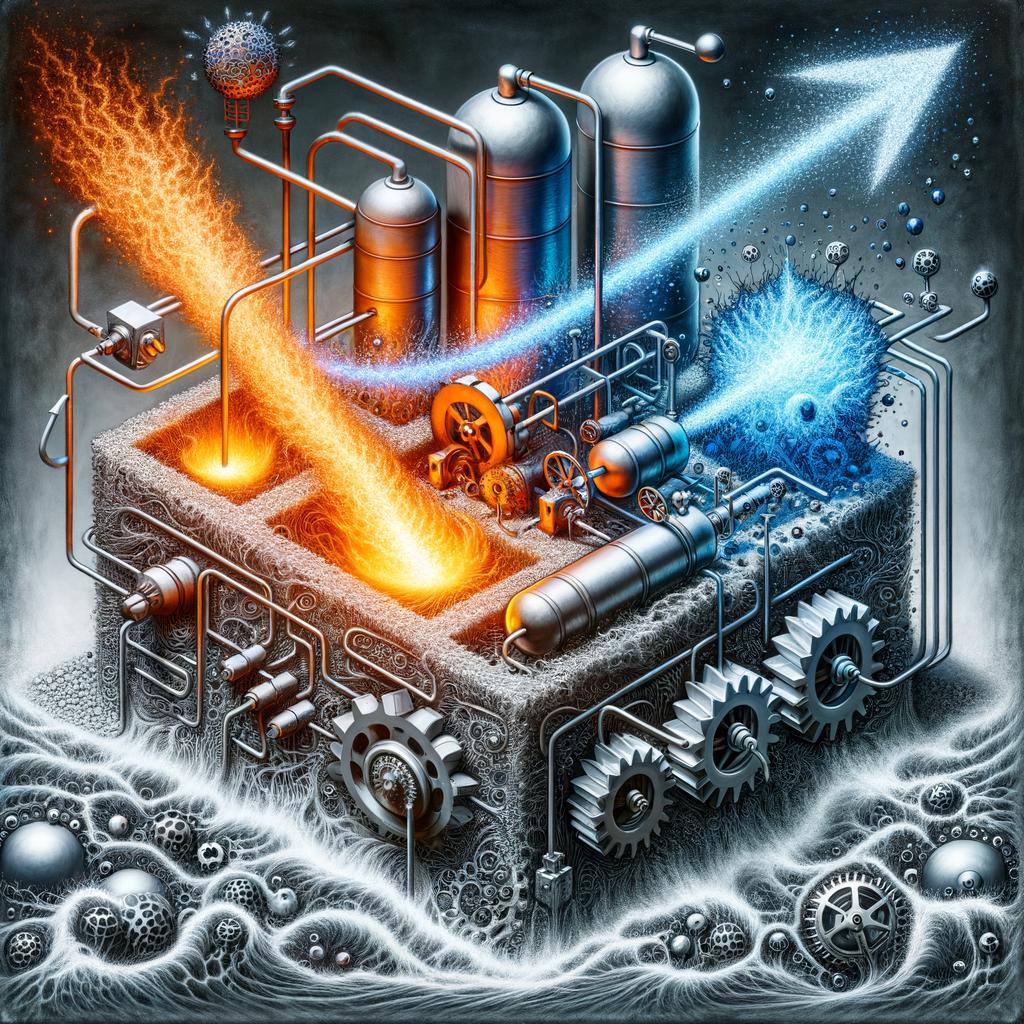
entropy plays a pivotal role in determining how energy is transferred within systems and the efficiency with which these transfers occur. At it’s core, entropy describes the degree of disorder in a system; as a system becomes more disordered, the potential energy available for work diminishes. This fundamental principle explains why, in natural processes, energy tends to disperse and spread out rather than concentrate. From the functioning of heat engines to biological systems, understanding entropy is vital for examining energy flows.
In thermal processes, such as in heat engines, the second law of thermodynamics states that the total entropy of a closed system can never decrease over time. This means that during energy conversion, some energy will always be lost as waste heat, contributing to an increase in the system’s entropy. This irreversibility inherently limits the efficiency of engines, as maximum efficiency is unattainable due to the unavoidable increase in entropy. Hence,improvements in engine design and operation often focus on minimizing entropy generation,thereby enhancing overall performance.
Biologically, organisms can also be viewed through the lens of entropy. Living systems maintain a highly ordered state despite the natural tendency towards disorder. They achieve this by constantly taking in energy from their habitat, typically in the form of food or sunlight, and using it to build cellular structures and maintain order. Though, this process is not without its costs; the energy expended in maintaining order leads to an increase in the surrounding environment’s entropy.Thus, the balance of entropy within biological systems underlines the intricate relationship between energy transfer, efficiency, and the natural laws governing thermodynamics.
Exploring the Real-World Applications of Entropy in Science and Engineering
Entropy, a fundamental concept in thermodynamics, plays a pivotal role in various scientific and engineering fields. In thermodynamics, it measures the disorder or randomness of a system, helping to predict the direction of spontaneous processes. This principle is not limited to physics; it extends into chemistry, where the concept is used to understand the spontaneity of reactions and the stability of molecular structures. The second law of thermodynamics stipulates that the total entropy of an isolated system can never decrease over time, leading to implications in energy conservation and efficiency.
In the realm of engineering, entropy is crucial for enhancing system performance and optimizing processes.As a notable example, the design of engines and heat exchangers hinges on the management of entropy. Engineers must account for entropy generation when determining the efficiency of energy conversion systems. Key applications include:
- Thermal Systems: Understanding how heat flows within a system to minimize energy loss.
- Facts Technology: Managing data uncertainty and redundancy in communication systems through algorithms that maximize information transmission.
- Renewable Energy: Optimizing processes such as biofuel production and solar energy conversion by understanding entropy changes in reactions.
Beyond conventional engineering applications, the implications of entropy extend into emerging fields such as quantum computing and information theory. In these areas, entropy serves as a measure of information content, influencing how data is stored and processed.the study of entropy also underpins concepts such as entropy encoding in data compression, which enhances storage efficiency and communication speeds. By exploring entropy’s role across diverse disciplines, scientists and engineers alike can harness its principles to drive innovation and create sustainable solutions for complex challenges.
entropy serves as a vital lens through which we can examine the complexities of physical systems. As both a measure of disorder and a critical component of the second law of thermodynamics, it underpins the behavior of energy transfer and transformations in our universe. Whether exploring the efficiency of engines, the spontaneity of chemical reactions, or the very nature of time itself, a solid grasp of entropy enriches our understanding of how the world operates. As we continue to investigate these principles, we uncover deeper insights into the balance of order and chaos that defines the natural world. By embracing the concept of entropy,we not only enhance our appreciation of physics but also gain a more profound viewpoint on the processes that govern all aspects of existence.