
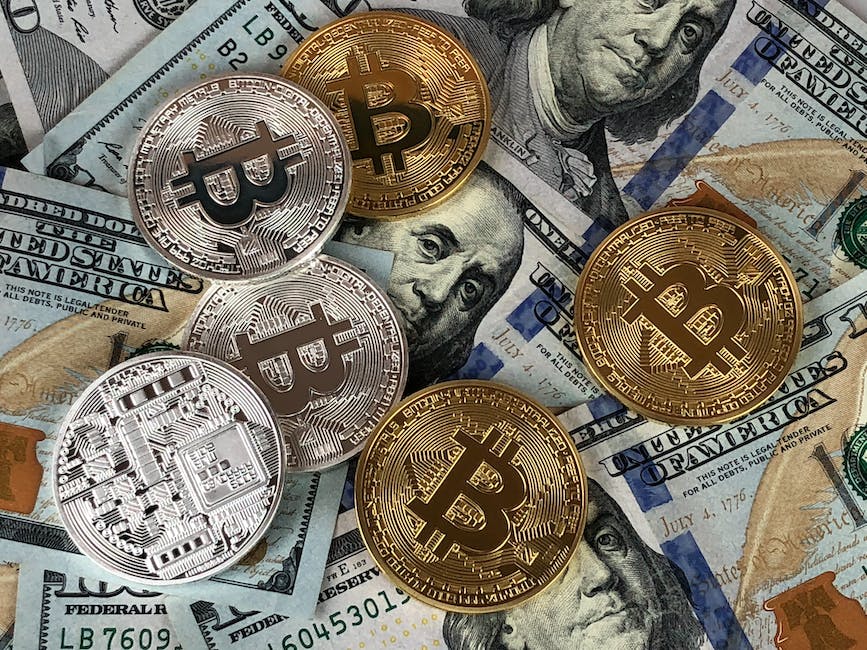
The digital age has brought with it a wave of new and innovative technologies that are rapidly transforming the global economy. Over the past decade, one such technology has captured the imaginations of investors from all across the world; that is, the cryptocurrency known as Bitcoin. Bitcoin in particular has seen an astronomical surge in popularity and value over the past few years, making it a prime investment opportunity for those looking to maximize their finances. As such, it is only natural to ask, what exactly is driving this remarkable rise in bitcoin and what impact is it having on the global financial market? In this article, we will take a closer look at the burgeoning phenomenon of bitcoin to explore the questions of its value, underlying drivers, and implications.
1. Bitcoin’s Rapid Rise: The Start of a New Financial Era?
Within a mere decade, Bitcoin has had an explosive growth, transforming from a largely unknown concept to a mainstream topic. From its inception in 2009, it quickly gained value and popularity due to its decentralized nature, and its success carries implications for the future of finance and the economy.
Bitcoin’s success is primarily due to its innovative feature: lack of a centralized, governing authority. Unlike traditional currencies, which are supported by banks and states, Bitcoin functions without any single entity controlling and regulating it. Whilst this grants users autonomy and privacy, it has also traditionally been somewhat risky. However, as its value has risen, users of Bitcoin have become increasingly more trusting of the autonomous digital currency.
- It quickly gained value and popularity due to its decentralized nature.
- Unlike traditional currencies, it functions without any single entity controlling and regulating it.
- As its value has risen, users of Bitcoin have become increasingly more trusting of the autonomous digital currency.
The sustainability of Bitcoin, and its place as a secure form of payment, remains to be seen. But, its rapid rise is a clear sign of a possible shift in the way financial transactions are conducted – one that doesn’t require any central governing body and is completely transparent. Whether this financial revolution will happen in the near future or not, one thing is clear: Bitcoin has taken the world by storm.
2. Exploring the Potential of Cryptocurrency as a Commodity
Cryptocurrency is a digital asset, a medium of exchange, and a commodity. With the growing interest and development in the cryptocurrency world, it is becoming increasingly important for potential investors and users to understand how it works and how it can potentially be used as an asset.
Firstly, an important point to note is that cryptocurrency does not follow the same trends as traditional markets. Beyond the worldwide market, cryptocurrency exchanges can be subject to country-specific laws and regulations. This creates an additional layer of complexity for potential users. Secondly, blockchain technology, the backbone of cryptocurrency, has the potential to enable faster and simpler trading when compared to traditional markets. This provides an opportunity for faster trading, including for day-trading. Additionally, cryptocurrency can be easily used as a medium of exchange – it is accepted as payment for a wide range of goods and services. Lastly, cryptocurrency has certain monetary properties which make it an attractive commodity for investors looking to diversify their portfolios.
- Cryptocurrency does not follow the same trends as traditional markets
- Blockchain technology has the potential to enable faster and simpler trading
- Cryptocurrency can be used as a medium of exchange
- Cryptocurrency has certain monetary properties which make it an attractive commodity
3. Bitcoin’s Impacts on Traditional Financial Systems
The emergence of cryptocurrencies such as Bitcoin has had measurable impacts on traditional financial systems. Bitcoin’s fast transaction times, low fees and borderless nature have made it an attractive way to make low-cost payments.
In reaction to the adaptation of this technology, many traditional financial systems, such as banks and governments, have started to explore ways to incorporate cryptocurrency. Central banks are exploring the possibility of issuing their own digital currencies, and banks are rolling out new mobile payment apps that incorporate peer-to-peer financial services. These changes are not only reducing costs but also potentially improving customer experiences.
- Banks are adapting to cryptocurrencies by exploring the option of offering their own digital currencies
- The changes associated with this adaptation are reducing costs and improving customer experiences
- The fast transaction times, low fees and borderless nature of cryptocurrencies make them an attractive payment option
In conclusion, the rise of Bitcoin is a significant moment in the world of finance. Its decentralized nature has the potential to revolutionize the way we transact with one another, while its increasing value could make it a new commodity. While its future is still uncertain, the fact that it has gained such traction among investors is undeniable, and it will be interesting to see where its growth takes it in the years to come.