

Decentralized Relay Architecture and Data Availability: Topology, Threat Model, and Design Recommendations for Scalable, Resilient Relays
Relays function as lightweight, append‑only event stores and pub/sub brokers within the larger ecosystem, and their placement in the overlay network determines practical data availability. Typical deployment patterns are client‑centric: users publish to multiple autonomous relays and subscribe to sets of relays to assemble a partial view of the global event graph; alternative topologies-peer‑to‑peer replication among relays, hierarchical caching relays, or regional clusters-are possible but require explicit replication protocols. Availability is therefore emergent: it depends on the replication factor (how many relays retain a given event), retention and eviction policies, and the efficiency of per‑relay indices and subscription filters that satisfy range and tag queries.Because events are immutable and content‑addressed by their cryptographic identifiers,deduplication is straightforward,but queryability and completeness remain constrained by the intersection of client subscription choices and relay retention horizons.
In assessing adversarial capacity and operational failure modes, several vectors are salient:
- Censorship by isolated relays: single relays may refuse to accept, store, or forward particular events or subscriptions, denying availability to clients that rely solely on them.
- Collusion and Sybil amplification: a collection of malicious relays under a single operator or Sybil identities can control perceived replication and inject or suppress views of history.
- Traffic analysis and deanonymization: because relays observe connection metadata,passive observers can correlate publishing and subscribing behavior to link keys to network identifiers.
- equivocation and inconsistent indexing: relays may provide different query results over time or between peers, producing forked perceptions of event ordering and availability.
- Resource exhaustion attacks: high‑volume writes, pathological subscription patterns, or malformed filters can overwhelm storage, compute, or I/O, reducing observable availability for honest users.
These threats vary in result: signature cryptography defends authenticity, but not availability or privacy; operational controls and protocol design must thus address storage, replication, and traffic confidentiality separately.
To support scalability and resilience, implementers should prioritize a set of complementary mitigations and design patterns:
- Replication diversity: require clients to publish to and subscribe from multiple, independent relays; relays should advertise and track peer sets to encourage orthogonal storage of events.
- Probabilistic and deterministic routing: combine deterministic placement (e.g., sharding by event ID prefix) with probabilistic replication (randomly selected mirrors) to bound availability loss while limiting per‑relay load.
- Adaptive backpressure and concurrency control: use non‑blocking I/O, bounded worker pools, and request prioritization to contain abusive patterns; expose rate limits and resource usage metrics to clients.
- Compact indices and selective retention: maintain lightweight time‑ and tag‑based indices, employ tiered storage (hot indexes, cold archival stores or erasure‑coded blobs), and advertise retention semantics so clients can make informed subscription choices.
- Privacy-preserving transports: recommend encrypted, metadata‑minimizing transports and encourage use of network‑level anonymity where required to reduce deanonymization risk.
Together these measures create a pragmatic tradeoff space: increase replication and diversity to improve availability, invest in indexing and sharding to raise throughput, and deploy operational controls to constrain adversarial impact while preserving the protocol’s simple, decentralised ethos.
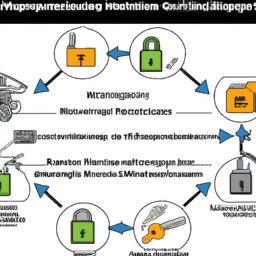
Cryptographic Key Management and Lifecycle Policies: Secure Generation, Storage, Rotation, and Migration Paths Including Threshold Schemes and Hardware-backed Keys
Secure key material for Nostr identities must be generated and stored under well-defined, auditable procedures. Generation ought to use a cryptographically secure random number generator or hardware entropy sources, with deterministic mnemonic seeds (e.g., BIP‑39-style) reserved for interoperable backups and recoveries only after weighing the increased attack surface. Because Nostr identities are directly tied to secp256k1-derived public keys, compromise of a single private key results in full identity takeover; consequently, lifecycle policies should mandate explicit classification of keys as authority keys (long‑lived, high‑risk) versus operational keys (short‑lived, replaceable), and include technical controls such as encrypted backups, split backups, and mandatory use of attested hardware modules where feasible.
Rotation, revocation, and migration must be practical within the protocol’s event model and resilient to censorship. Effective rotation policies define triggers (time, usage counts, suspected compromise), timelines (grace and epoch windows), and authoritative revocation channels; one pragmatic pattern is chaining signed “replacement” events that link the retiring public key to a successor via a signature from the retiring key, optionally augmented by protocol-level delegation tokens. To support robust migration and threshold schemes, implementations should consider:
- Atomic key handover: sign a migration manifest with both old and new keys and publish it across multiple independent relays to reduce single-point suppression.
- Threshold signing: adopt aggregated Schnorr/MuSig2 or MPC constructions to distribute signing power across parties or devices, reducing single-key compromise risk while preserving compact signatures compatible with secp256k1.
- Social and escrowed recovery: combine Shamir-like secret sharing for seed shards with time‑locked or multisignature recovery policies to reconcile availability and security.
These measures should be codified in a verifiable policy that clients can use to automatically validate migration artifacts and to minimize epoch overlap that could create replay or impersonation windows.
Hardware-backed key storage and attested signing substantially raise the bar against theft but introduce operational and privacy tradeoffs that must be controlled via policy. Use of HSMs, Secure Enclave, or certified hardware wallets should be accompanied by well-defined key usage policies (e.g., offline signing, rate limits, administrator roles) and by minimizing identifiable attestations in network messages to avoid hardware-based linkability.For enhanced censorship resistance, combine hardware-backed keys with the following mitigations:
- key separation: use distinct keys or delegated subkeys per relay or social context to reduce cross-relay linkability.
- Distributed escrow: store backup shards across independent custodians rather than a single cloud provider.
- Threshold signing for publishing: require multiple geographically and administratively separated signers to authorize high-impact events.
Implementers must balance usability (seed recovery, device migration) against the increased complexity of threshold and hardware-backed schemes, and formal audits of key management workflows are essential to ensure that cryptographic guarantees translate into operational security without undermining privacy or availability.
Metadata and Linkability Risks to Privacy: Minimization Techniques, Client-side Obfuscation, and Protocol extensions for Encrypted Relay Interaction
Decentralized message exchange on public relays creates a rich surface for metadata collection and linkability: persistent public keys, event identifiers, timestamps, relay connection patterns, and explicit tag relationships all act as correlation vectors that enable profiling across time and across relays. Passive observers and relay operators can partition activity by public key and infer social graphs from reply/mention tags and repost patterns; active adversaries can further deanonymize clients by combining relay logs with network-level identifiers (e.g., IP addresses or repeated proxy endpoints). Long-lived keys and predictable client behaviors (regular posting schedules,identical client fingerprints,or deterministic event encodings) amplify the risk of persistent linkability even when payloads are encrypted or pseudonymous.
Mitigation at the client layer focuses on data minimization and obfuscation,balancing privacy gains against usability and performance costs. Practical techniques include:
- use of ephemeral or per-conversation key pairs to limit long-term correlation;
- reducing and normalizing tags and authored metadata before publication to remove needless linkable fields;
- introducing randomness in timestamps and event identifiers (padding/time-jitter) to complicate temporal correlation;
- client-side content padding and chunking to thwart size-based fingerprinting;
- routing through privacy-preserving transports (Tor, I2P, or VPNs) and rotating relay selections to reduce network-level linkability.
These approaches should be applied selectively and with awareness of trade-offs: excessive padding or jitter degrades timeliness and increases relay storage/ bandwidth costs, while ephemeral keys complicate discoverability and reputation mechanisms. Implementations must document the privacy/usability trade-offs and provide configurable defaults geared to threat models.
At the protocol level, extending relay semantics to support encrypted relay interaction and metadata minimization can materially reduce systemic risks. Candidate extensions include encrypted-at-rest relay storage where relays store ciphertext without indexing sensitive tag fields, authenticated blind indexes for searchable retrieval without revealing cleartext tags, and relay-side access control that enforces minimal retention policies and strips observational metadata (e.g., client IP hashes not retained beyond short windows). Additional primitives worth specifying are forward-secret key exchange for ephemeral conversations (building on existing direct-message NIPs), multiplexed relay sessions tunneled over onion routing, and standardized headers that indicate intentionally withheld metadata so clients and auditors can reason about privacy guarantees. Any protocol modifications must be accompanied by formal threat models and measurable privacy metrics (linkability, indistinguishability, and disclosure risk) and should consider incentives for relay operators-such as verifiable deletion proofs or selective encryption attestations-to resist coercion and censorship while preserving auditability where required.
Censorship Resistance and Abuse Mitigation: Reputation-driven Relay Selection, Verifiable Replication, and Privacy-preserving Discovery Mechanisms
Designing a robust method for relay selection that limits censorship requires explicit, auditable metrics rather than ad-hoc client heuristics. A reputation-based model can be grounded in measurable behaviors-uptime, acknowledgement latency, rate of event suppression (observed conflicts between published and served events), and cryptographic evidence of tampering. Clients should collect and exchange signed telemetry about relays under a defined schema so reputation computations are reproducible; this reduces reliance on centralized directories while enabling clients to prefer relays with demonstrable histories of neutral behavior. Importantly, any reputation system must incorporate Sybil-resistance techniques (e.g., cost or proof-of-work anchors for assertion publication) and provide opt-in privacy controls so that clients contributing telemetry are not deanonymized by their participation in reputation gossip.
Ensuring long-term availability and provable non-censorship requires mechanisms for verifiable replication and cross-relay attestation. replication can be incentivized and audited by means of signed replication receipts and compact cryptographic proofs of storage or delivery (for exmaple, space-time commitments or periodic Merkle-root anchors of archived event sets that relays publish). When a client publishes an event it should be able to obtain and later present a chain of signed receipts from multiple relays demonstrating propagation; these receipts serve both as evidence of publication and as a deterrent against retrospective deletion. Architectural designs should standardize receipt formats and retention policies to prevent equivocation while minimizing on-chain dependencies-anchoring only periodic digests to an independent ledger when strong, immutable provenance is required.
Discovery must balance censorship resistance with user privacy: naive global indexing enables easy blocking and user deanonymization, while overly hidden discovery impedes usability. Practical, privacy-preserving primitives include private set intersection for mutual contact discovery, bloom-filter-based topic subscriptions with differential-noise padding, and selective private facts retrieval (PIR) for obtaining relay lists without exposing query contents.Complementary strategies involve ephemeral contact handles, directory multiplexing across many relays to increase cost for censors, and optional onion-routing for relay rendezvous. Proposed mitigations include:
- client-side filtering to limit exposed interests;
- Privacy-preserving indexing schemes (PIR, PSI, Bloom filters with noise);
- rendezvous obfuscation through multi-hop proxies or opportunistic multiplexing across unrelated services.
Each technique introduces trade-offs among latency, bandwidth, and provable censorship-evidence; a layered approach that composes light-weight privacy primitives with verifiable replication and reputational signals yields a pragmatic path toward resilient, abuse-tolerant operation.
In this analysis we examined Nostr’s deliberately minimal architecture – a public‑key identity model combined with simple, relay‑based event distribution – and evaluated how those design choices interact with key management, security properties, and user privacy. The protocol’s simplicity yields meaningful advantages: low implementation complexity, clear cryptographic ownership of content, and an architecture that can resist unilateral takedown when relay diversity is high. At the same time, that same simplicity exposes practical vulnerabilities. Relays observe plaintext events and metadata, enabling correlation, profiling, and censorship by unfriendly or compromised operators; the lack of built‑in forward secrecy and limited native anti‑spam measures increase the risk posed by key compromise, Sybil attacks, and mass‑posting abuse; and usability gaps around key generation, storage, and rotation raise the likelihood of human error undermining cryptographic guarantees.
Mitigations exist at both the client and protocol levels. Robust key management – hardware or secure enclaves for private keys, deterministic and well documented backup/rotation procedures, and, where appropriate, the use of ephemeral keys for sensitive interactions – reduces single‑point failure risks. End‑to‑end encryption for private messages, onion routing or SOCKS/Tor support for relay connections, and metadata‑minimization practices on clients can materially improve privacy. Protocol extensions and ecosystem practices (relay reputation systems, distributed indexing, economic or computational spam costs, and optional content‑encryption NIPs) can increase resilience to censorship and abuse without sacrificing the protocol’s openness.
Future work should prioritize rigorous threat modeling, empirical measurement of relay ecosystems and metadata leakage, and usability studies that reconcile strong key hygiene with mainstream user expectations. comparative evaluation of privacy enhancements (mixing, cover traffic, or lightweight onioning) and formal analysis of proposed NIPs will help stakeholders understand trade‑offs in latency, bandwidth, and deployability. interdisciplinary collaboration between protocol designers,implementers,and researchers is essential to align cryptographic best practices with real‑world deployment constraints.
In sum, Nostr’s foundational design offers a promising basis for decentralized social interaction, but realizing its potential at scale requires deliberate improvements in key management, privacy protections, and anti‑abuse mechanisms. Addressing these challenges-through careful protocol evolution, tool support for secure key handling, and ongoing empirical research-will determine whether the platform can deliver meaningful censorship resistance and privacy guarantees while remaining accessible to a broad user base. Get Started With Nostr