
Understanding the total Supply of Bitcoin and Its Implications for the Market
Bitcoin’s design includes an intriguing limitation that directly impacts its market dynamics: the total supply cap of 21 million coins. This finite ceiling establishes an inherent scarcity that differentiates Bitcoin from customary fiat currencies, which can be printed at will by central banks. As demand fluctuates against a constant supply, the economic principles of scarcity and value become profoundly intertwined. The mathematical certainty underlying Bitcoin’s issuance imbues it with credibility and has positioned it as a potential store of wealth in a digital era.
Investors are increasingly recognizing the implications of this scarcity. The concept of “Satoshis,” the smallest unit of Bitcoin, furthers this narrative of limited supply. With a singular Bitcoin divisible into 100 million Satoshis, the effective supply becomes a staggering 2.1 quadrillion Satoshis. This granularity allows for practical transactions and micro-payments, ensuring accessibility even as larger units become more valuable.However, the total cap poses critical questions about future market behaviour as more individuals and institutions seek a stake in this limited resource.
Speculation surrounding Bitcoin’s value is heavily influenced by its capped supply, which could lead to a price appreciation cycle as adoption increases.Many analysts argue that once a critical mass of investors recognizes Bitcoin as a hedge against inflation and currency devaluation, the price could skyrocket due to the supply-demand disparity.The psychological aspect of owning a share of a finite asset could create a further rush to acquire Satoshis, thereby exacerbating volatility and possibly leading to speculative bubbles. As the cryptocurrency landscape evolves, understanding the importance of Bitcoin’s supply limitation will be pivotal for investors and policymakers alike.
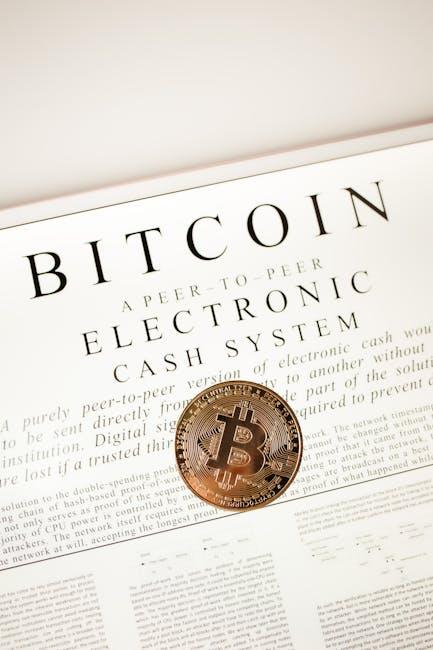
The Significance of satoshi: The Smallest Unit and its Impact on Transactions
The concept of Satoshi, which is the smallest unit of Bitcoin, represents a pivotal component in the realm of digital transactions. With 1 Bitcoin equating to 100 million satoshis, this granular division enables incredibly precise transactions, catering to both micro-payments and larger trades. This structure not only facilitates a scalable approach to Bitcoin’s utility but also serves as a bridge for users unfamiliar with Bitcoin’s current market value. In contrast to traditional currencies,where coins and notes limit the smallest units,Satoshis allow for unparalleled flexibility in digital finance,empowering users to transact in fractions of a penny with ease.
Moreover, the finite nature of Satoshis accentuates their significance in a world increasingly driven by scarcity. With a cap of 21 million Bitcoins, the total supply of Satoshis tops out at 2.1 quadrillion, presenting intriguing dynamics of supply and demand. This limitation fosters an environment where the value of Bitcoin-and consequently its smaller units-may appreciate over time as adoption accelerates. The implications for investors, merchants, and everyday users are profound. Understanding this scarcity is essential, as it directly influences the threshold at which individuals perceive Bitcoin as both a store of value and a medium of exchange.
Furthermore,as cryptocurrencies gain traction across various sectors,the ability to utilize Satoshis enhances Bitcoin’s accessibility to a broader audience. For example, purchasing digital goods, including music and artwork, becomes more viable when transactions can be conducted at the Satoshi level, allowing for affordable and precise payments. This trend aligns with the increasing movement towards digital economies where micro-transactions become commonplace. As merchants begin accepting Bitcoin in smaller increments, the landscape for digital commerce transforms, paving the way for a new economic paradigm where value is not only stored but also seamlessly exchanged at unprecedented scales.
Assessing Scarcity: Analyzing the Finite Nature of Satoshis in a Growing Economy
The total supply of Bitcoin, defined by a hard cap of 21 million coins, translates into a staggering 2.1 quadrillion Satoshis. This figure frequently enough serves as a focal point in discussions surrounding the cryptocurrency’s inherent scarcity, which is pivotal in shaping its market value amid an ever-expanding digital economy. As demand for Bitcoin rises, driven by speculation and institutional adoption, the finite supply of Satoshis inevitably highlights their role as a hedge against inflation, contrasting sharply with fiat currencies that can be printed at will.
As the economic landscape evolves, several factors contribute to the increasing value perception of these smallest Bitcoin units. Notably:
- Investor Sentiment: Growing institutional investment creates heightened competition for the limited supply.
- Market Dynamics: A surge in retail investors coupled with limited availability means prices could rise disproportionately.
- Technological Integration: As payment systems increasingly adopt Bitcoin, the need for smaller denominations like Satoshis becomes pronounced.
This constellation of elements not only underscores the increasing prominence of Satoshis but also suggests that even minor fluctuations in availability could have outsized impacts on market valuations.
The intrinsic value ascribed to Satoshis reflects broader economic principles of supply and demand, particularly within a deflationary framework. Unlike traditional currencies that may depreciate due to unrestrained supply, Bitcoin’s capped issuance fosters a perception of value retention over time, especially during periods of economic uncertainty. Within this context, the transition from viewing Bitcoin as merely a digital currency to recognizing it as a scarce asset class is a critical shift. It demands a reevaluation of asset allocation strategies for both individual and institutional investors seeking to navigate the complexities of an increasingly digitized economy.
Strategic Insights: Recommendations for Investors in a Fixed Bitcoin Ecosystem
The concept of a fixed Bitcoin ecosystem presents a unique landscape for investors, especially considering the finite supply of Satoshis. As the maximum supply of Bitcoin is capped at 21 million, understanding this limitation not only informs investment strategy but also heightens the importance of scarcity in value determination.Investors should approach their decisions by considering the dynamics of supply and demand, where the reduced availability of Bitcoin could lead to price appreciations over time.
To navigate this fixed ecosystem effectively, investors are encouraged to adopt a long-term viewpoint. Instead of reacting to short-term market fluctuations, maintaining a steady accumulation strategy can be beneficial. Consider the following strategies:
- Dollar-cost averaging: Regularly investing a fixed amount can mitigate the impact of volatility.
- Diversification: Rather of concentrating solely on Bitcoin, exploring complementary assets within the cryptocurrency realm might provide balanced risk exposure.
- Continuous research: Staying updated with market trends and infrastructures supporting Bitcoin can offer insights into potential growth areas.
Moreover, investors should remain vigilant about technological advancements and regulatory changes that could affect Bitcoin’s ecosystem. Innovations such as the layer-2 solutions aim to enhance scalability and transactional efficiency, potentially increasing Bitcoin’s utility and desirability. Engaging with community discussions and expert analyses can reveal emerging trends, equipping investors to anticipate market moves. With the inherent limitations of Bitcoin in mind, strategic foresight will be essential for those looking to maximize their investments in this finite digital currency landscape.
As we conclude our exploration of the finite nature of satoshis, it becomes clear that understanding the inherent limitations of Bitcoin’s smallest unit is crucial for both investors and enthusiasts. The ceiling of 2.1 quadrillion satoshis serves as a reminder of the carefully engineered scarcity that underpins Bitcoin’s value proposition. This finite supply is not merely a technical specification; it is a foundational principle that shapes market dynamics and influences investor sentiment.
The implications of this limitation ripple through the cryptocurrency ecosystem. As the adoption of Bitcoin grows and its desirability escalates, the finite supply of satoshis could potentially drive up demand, leading to increased volatility and market speculation. Moreover, this scarcity invites a broader discussion about the future of digital currencies and the role of decentralized finance in an increasingly digitized economy.
In essence, grasping the significance of the 2.1 quadrillion satoshis limit encourages us to reflect on the philosophical underpinnings of value itself-what it means to have something finite in a world often driven by infinite ambition. As the landscape continues to evolve,keeping a keen eye on the interplay between scarcity and demand will be paramount for anyone looking to navigate the complexities of the cryptocurrency frontier.