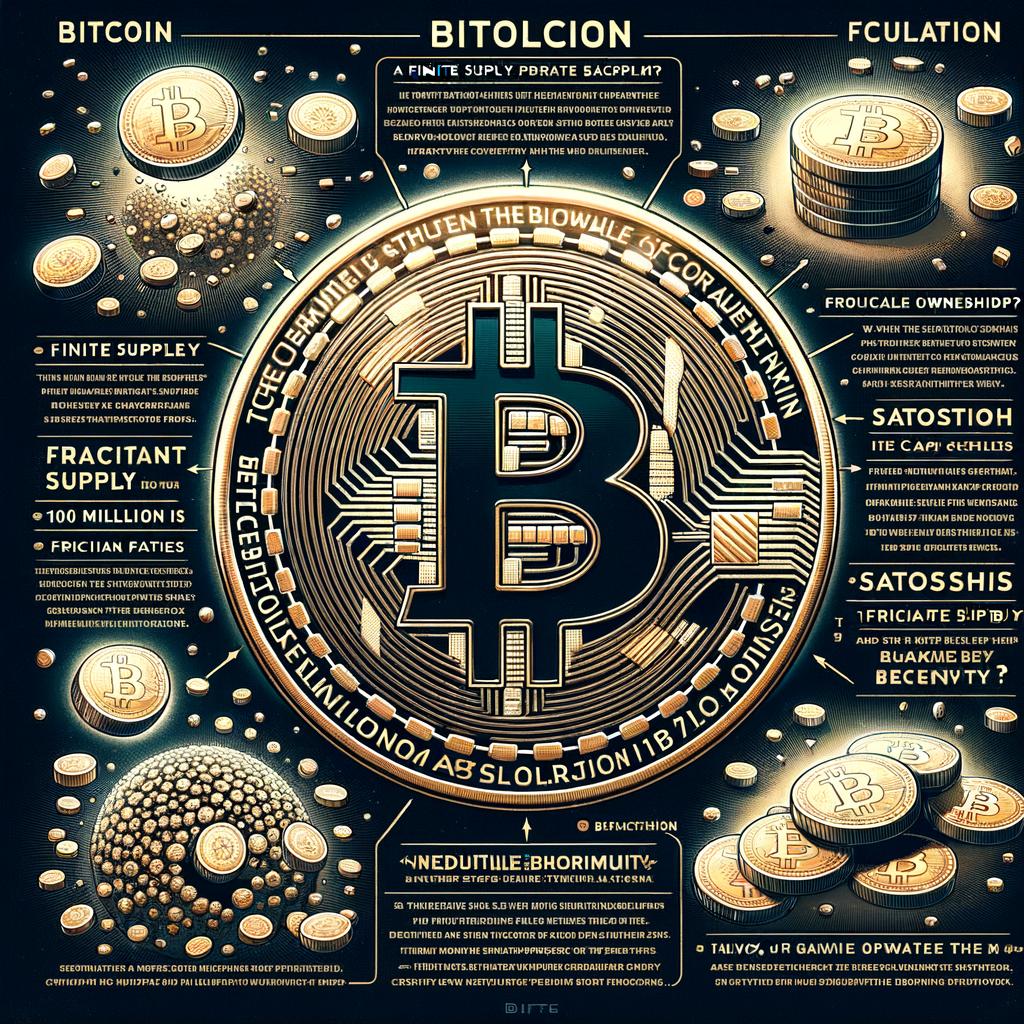
- Understanding the satoshi: The Building Blocks of Bitcoin’s Finite Supply
The concept of a Satoshi, named after Bitcoin’s pseudonymous creator Satoshi Nakamoto, represents the smallest unit of Bitcoin, with one Bitcoin equal to 100 million Satoshis. This ingenious division allows for fluid transactions and precise pricing, especially in an ecosystem where the value of Bitcoin can fluctuate dramatically.As the cryptocurrency market stabilizes and matures, the role of Satoshis becomes increasingly significant, ensuring that Bitcoin remains accessible to users regardless of the unit’s market valuation.
At the heart of Bitcoin’s design is its finite supply, a feature that is paramount to its value proposition. With a total cap of 21 million Bitcoins,translating this to Satoshis reveals a staggering total supply of 2.1 quadrillion Satoshis. This hard limit serves not just as a deflationary mechanism, but also enhances the currency’s scarcity appeal. The mathematical framework underlying Bitcoin’s supply means that,unlike fiat currencies,there is no possibility for inflation driven by central banking systems that can lead to rampant money supply increases.
As Bitcoin adoption grows and more individuals enter the ecosystem, the granularity provided by Satoshis will become increasingly crucial.This unit of measurement allows for fractional ownership, addressing the potential barriers posed by high Bitcoin valuations. The psychological framing of value in satoshis can promote wider participation, making it easier for users to hold, transact, and invest without the burdensome need to own whole Bitcoins. In the long run, understanding this fractional structure not only aids in comprehension of Bitcoin’s supply limitations but also reinforces its role in redefining the landscape of decentralized finance
The known limit of 2.1 quadrillion satoshis introduces a new paradigm for the future of cryptocurrency adoption. As more investors and users become aware of this finite supply, psychological factors may play a crucial role in shaping market dynamics. The perception of scarcity often drives demand; thus, as the number of available satoshis dwindles, an increase in interest and investment may ensue, especially from those wary of traditional fiat currencies’ inflationary tendencies. This shift could lead to enhanced acceptance of Bitcoin and other cryptocurrencies as not just speculative assets, but also as credible mediums of exchange.
Moreover, the cap on satoshis raises questions about the long-term viability of existing cryptocurrencies in a market that values limited supply. With Bitcoin leading the way, other altcoins may feel the pressure to establish their own unique value propositions. Innovations such as layer-2 solutions, decentralized finance (DeFi) applications, and non-fungible tokens (NFTs) could emerge as critical components in growing the ecosystem.Investors may begin to favor projects that not only offer technological advantages but also possess a clear path to maintaining scarcity and value over time.
the 2.1 quadrillion limit could spur regulatory bodies to clarify stances on cryptocurrencies as official currencies rather than mere assets.Governments worldwide could start recognizing the potential of a finite currency in stabilizing economic ecosystems. This recognition might lead to a more structured regulatory framework, laying the groundwork for how cryptocurrencies are integrated into the mainstream economy. Thus, with increased legitimacy, Bitcoin and its finite supply could serve as a cornerstone for broader financial innovations and adoption, presenting a compelling case for both individuals and institutions to participate in the digital currency frontier.
– Balancing Scarcity and Usability: The Economic Impact of Bitcoin’s Satoshi Cap
The intriguing interplay between scarcity and usability presents a unique economic dynamic in the realm of Bitcoin. the cap of 21 million Bitcoins,equating to a staggering 2.1 quadrillion Satoshis, sets a foundational limit that deeply influences the cryptocurrency’s value proposition.This artificial scarcity, akin to that of precious metals, enhances Bitcoin’s appeal as a store of value. As demand for Bitcoin continues to grow, this finite supply means that holders are less inclined to spend their assets, further driving prices upward due to the fundamental economic principle of supply and demand.
Though, the Satoshi cap does not come without its challenges. As Bitcoin’s popularity surges, the finite nature of its total supply can lead to concerns regarding usability. For everyday transactions, the rising cost per Bitcoin can inhibit its role as a practical currency. elements such as transaction fees and speed become critical factors. If the cost of using Bitcoin eclipses that of traditional payment systems, its viability in daily commerce diminishes, possibly relegating it to a mere store of value rather than a medium of exchange.
To mitigate these issues, various solutions are being explored within the Bitcoin ecosystem, including layer-2 protocols and advancements in transaction processing technology. These innovations aim to enhance Bitcoin’s transaction efficiency without altering its core scarcity principle. By allowing smaller amounts of Bitcoin to be transacted quickly and cost-effectively, these developments could help strike a balance between maintaining scarcity and improving usability, ensuring Bitcoin’s place in both investment portfolios and everyday economic interactions.
– Strategic Recommendations for Investors in a Deflationary asset Environment
In an environment marked by declining asset values, investors must adopt a strategic approach to navigate the complexities of deflationary currencies like Bitcoin. Diversification has never been more critical; investors should consider distributing their portfolios across a range of deflationary assets to mitigate risks associated with market volatility. This can include not only cryptocurrencies but also precious metals and other anti-inflationary assets that generally hold their value in times of economic contraction.
Moreover, maintaining a keen awareness of market trends can provide crucial insight into potential investment opportunities. Utilizing technical analysis tools to track price movements, trading volumes, and market sentiment will enable investors to make informed decisions. Keeping a close eye on factors that could influence the Bitcoin market, such as regulatory developments or macroeconomic indicators, will help investors adjust their strategies effectively.Awareness of these dynamics will allow for a more proactive approach, as the current deflationary trends can herald both risks and opportunities.
understanding the underlying technology and principles governing deflationary assets is essential for making sound investment choices. Education around Bitcoin’s supply cap and its implications for scarcity is paramount. recognizing how the 2.1 quadrillion Satoshi limitation affects broader market perceptions and investor behavior will empower individuals to time their entry and exit points with greater precision. For instance, as scarcity becomes a more prominent theme, positioning oneself ahead of market shifts can yield significant long-term benefits.
understanding the 2.1 quadrillion satoshis limit is crucial in navigating the landscape of bitcoin’s monetary policy and its implications for the future of digital currency. As we explore the intricacies of this finite supply,it becomes clear that the capped issuance of Bitcoin not only strengthens its scarcity but also sets the stage for potential economic shifts and value dynamics within the crypto ecosystem. With digital assets gaining traction globally, the correlation between the satoshi limit and market behavior will undoubtedly merit further scrutiny. Stakeholders, investors, and enthusiasts alike must remain vigilant as we decode the complexities of bitcoin’s structure, ensuring informed decisions in an ever-evolving financial landscape. As the digital currency narrative unfolds, the finite nature of Bitcoin may pave the way for an ongoing dialog around value, scarcity, and innovation in the world of finance.