

In a groundbreaking discovery that could reshape our understanding of the Red Planet, China’s Mars rover has uncovered signs of an ancient beach, providing compelling evidence of Mars’ potential habitability in its distant past. The finding,revealed by the china National Space Management (CNSA),suggests that vast bodies of water once ebbed and flowed across the Martian surface,creating environments that may have supported life. Researchers are now examining the implications of this discovery in the broader context of Mars’ geological history and its ability to harbor living organisms—insights that could pave the way for future explorations and the ongoing quest to answer the age-old question: Was there ever life on Mars?
Discovering Mars’ Ancient Coastal Landscape and Its Implications for Habitability
Recent findings from China’s Mars rover have unveiled a remarkable ancient coastal landscape on the Red Planet, providing compelling evidence that Mars once hosted water bodies similar to Earth’s oceans. Researchers have identified sedimentary rock formations typically associated with marine environments, suggesting that these structures could be remnants of ancient beaches. This groundbreaking discovery may reshape our understanding of Mars’ climatic history, revealing a planet that once thrived with liquid water and possibly created conditions conducive to life.
The analysis of these coastal features has led scientists to propose several implications regarding the planet’s habitability in its early history:
- Potential microbial life: The presence of water suggests environments that might have supported microbial life.
- Climate conditions: Stable climates may have existed long enough for life to develop.
- Geological processes: Understanding the erosion and sedimentation can offer insights into past atmospheric conditions.
Scientists are now re-evaluating data from various Mars missions with a focus on sedimentary geology to better understand the planet’s transition from a watery world to its current arid state. As we delve deeper into the mysteries of Mars,each discovery brings us closer to understanding how similar planets might harbor life beyond our Earth.
Geological Evidence Supporting the Existence of Water on Mars and Its Significance
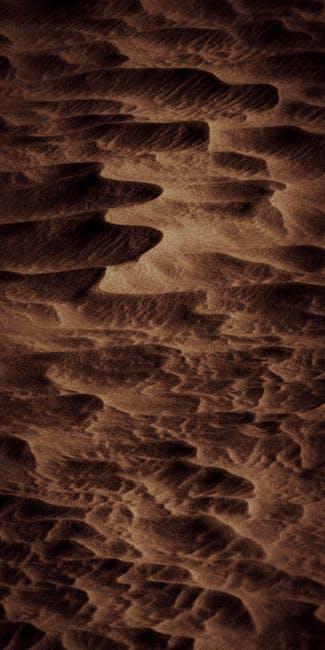
Recent findings from China’s Mars rover have unveiled geological features resembling an ancient beach,providing compelling evidence that liquid water once coursed across the Martian landscape.The discovery is significant as it aligns with prior research indicating that Mars had the necessary conditions for liquid water to exist on its surface billions of years ago.This evidence supports the hypothesis of a warmer, wetter environment that could have been hospitable to primitive life forms. Geologists are particularly intrigued by the presence of rounded pebbles and sedimentary rock layers, which together suggest the past presence of flowing water, a key ingredient for life.
The implications of these findings extend beyond geology; they bolster the case for the planet’s potential habitability in its ancient past. Understanding the role of water on Mars helps scientists piece together the planet’s climatic history and geological evolution. Key points of interest from the rover’s observations include:
- Mineral Deposits: The identification of clay minerals suggests the former presence of water, crucial for chemical reactions that support life.
- Topographical Analysis: High-resolution imaging reveals features consistent with coastal erosion, further supporting the beach hypothesis.
- Comparative Planetology: These findings allow researchers to draw parallels between Martian and terrestrial environments, enhancing our understanding of life’s potential beyond Earth.
| Feature | Significance |
|---|---|
| Rounded Pebbles | Indicate past water flow, suggesting a river or shoreline. |
| Sedimentary Layers | Provide evidence of historical environmental changes. |
| Clay Minerals | Point to wet conditions favorable for early life. |
Future Mars Missions: The Importance of Targeting Ancient Habitats for Life Exploration

The recent discovery of what appears to be an ancient beach by China’s Mars rover is a pivotal moment in our understanding of the red Planet’s history. This finding bolsters the argument that Mars may have harbored the conditions necessary for life. Scientists believe that the presence of ancient shorelines suggests that liquid water existed on the surface for extended periods, perhaps allowing microbial life to thrive.These ancient habitats display characteristics that could have supported diverse biological processes, making them prime targets for future exploration missions aimed at uncovering past life.
To effectively investigate these ancient environments, future Mars missions will need to prioritize specific geological formations that provide clear evidence of past habitability. Key habitats include:
- Ancient sedimentary rocks – which can reveal details about past water chemistry.
- Volcanic features - that may indicate geothermal activity, providing energy sources for life.
- Subsurface ice deposits – that could harbor preserved signs of past life.
This strategic targeting of ancient habitats will enhance our understanding of Mars’ evolutionary timeline and inform us about the potential for life beyond Earth.
Concluding Remarks
the discovery of what appears to be an ancient beach on Mars by China’s rover marks a significant milestone in our quest to understand the Red Planet’s past. This finding not only strengthens the case for the potential habitability of Mars millions of years ago but also opens new avenues for future exploration. As scientists analyze the data and images captured by the rover, they remain hopeful that further studies will yield more insights into the planet’s climatic history and the possibility of past life. With ongoing missions planned and international collaboration on the rise, the quest to unravel Mars’ mysteries is just beginning, inviting both scientists and enthusiasts to dream of the discoveries that lie ahead.