
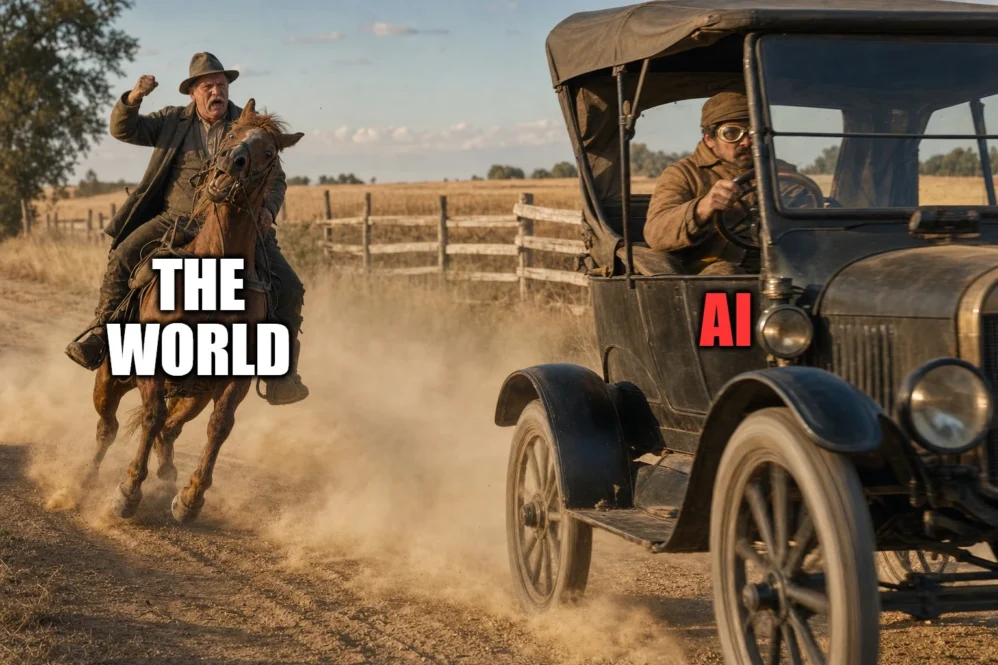
There is a man on horseback at the side of a dirt road. His fist is in the air, his face is red, and his horse is about to bolt. A Model T roars past in a cloud of dust, and the driver doesn’t even look over. Label the rider “The World” and the car “AI,” and you have one of the most honest pictures of 2026.
“Get a Horse!”
The scene isn’t made up. When cars first showed up on country roads in the early 1900s, people really did shout at them. “Get a horse!” was the popular insult for early drivers. Farmers said the machines scared their animals. Towns passed speed limits low enough to make walking competitive. In Britain, an older law had already required a person to walk ahead of some powered road vehicles waving a red flag.
The anger was real, and some of it was fair. Early cars were loud, unreliable and dangerous. The roads weren’t built for them. Nobody had worked out the rules yet.
But the car didn’t slow down. Henry Ford’s Model T arrived in 1908. Within about twenty years the horse went from the center of daily life to a hobby. Blacksmiths, stable hands and carriage makers watched their trades shrink. At the same time, whole new industries appeared: gas stations, mechanics, highways, motels, suburbs and road trips.
The Same Road, a New Machine
Swap the Model T for artificial intelligence and the picture still works. AI is moving faster than most people, companies and governments can react. It writes, draws, codes, answers phones and reads contracts. Every few months it gets noticeably better.
And the world is shaking its fist. Writers and artists worry about their work being copied. Office workers wonder if their jobs are next. Lawmakers are rushing to write rules for something they barely understand. Some of those worries are just as fair as the farmer’s complaint about his spooked horse.
Yet the history lesson is hard to ignore. Shouting at the car didn’t stop the car. The people who did well were the ones who learned to drive it, fix it, or build what it needed.
Why This Matters for Bitcoin Readers
Bitcoin holders have been the man on the horse and the driver of the car. For years, banks and regulators shook their fists at Bitcoin. Now Bitcoin is held in ETFs, on corporate balance sheets and by governments. The lesson from that ride applies to AI too. A new technology that is useful tends to win, even when it’s messy at the start.
AI and crypto are also starting to share the same road. AI agents need ways to pay for things online without a bank account, and digital money fits that job. Miners are renting out power and hardware to AI data centers. The two technologies that the world has yelled at the most may end up working side by side.
Pick Your Seat
The meme is funny because everyone has been that rider at some point. Change is uncomfortable, and it rarely waits for permission. But the dust settles. The roads get paved. The rules get written. The people who come out ahead are usually the ones who stopped shouting and climbed into the driver’s seat.
The car is already past us. The real question is whether we chase it, or learn to drive.