
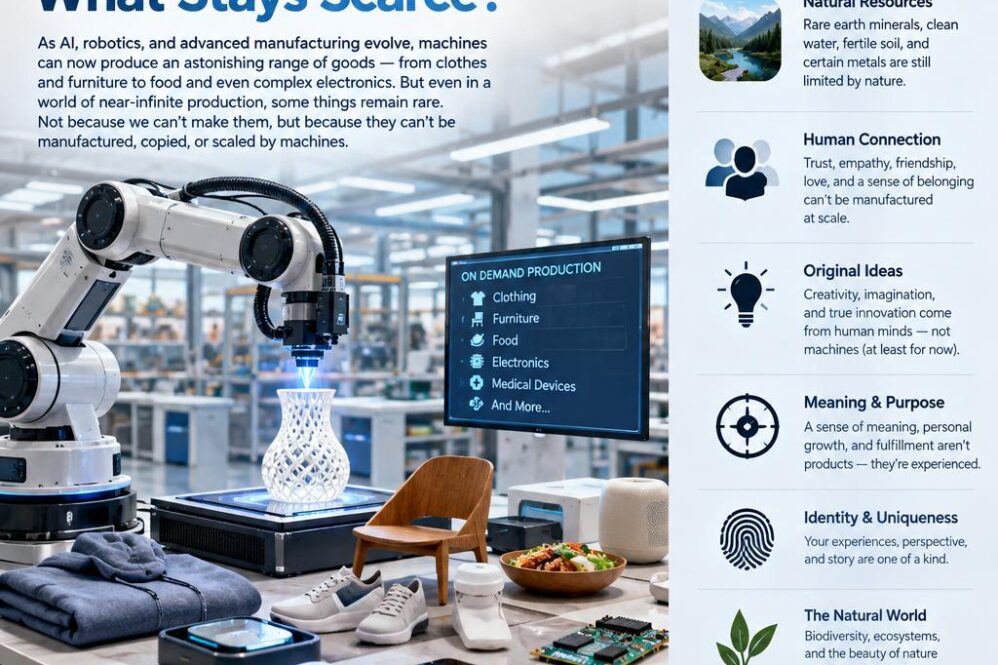
Manufacturers have a name for a factory that runs with no people on the floor: lights-out production. The machines do not need light, so nobody pays to turn it on. Parts arrive, robots assemble them, finished goods leave, and the building stays dark through the night shift.
For now, lights-out plants are the exception. But the direction of travel is clear. Artificial intelligence is writing software, robotics is learning to handle objects it has never seen, and the cost of turning an idea into a physical product keeps falling. If that trend holds, a question that sounds like science fiction becomes a practical one for anyone who saves or invests: when machines can produce almost anything, what is left that cannot simply be produced more of?
Abundance changes what “valuable” means
Prices are, at bottom, a record of scarcity. Something costs a lot when there is little of it relative to what people want, and it gets cheap when production catches up. History is full of examples. Aluminum was once a luxury metal, prized above gold, until new refining methods made it ordinary enough to wrap sandwiches. Computing power that once filled a building now fits in a pocket.
If AI and robotics deliver on even part of their promise, more categories of goods, services and intellectual output could follow that same path from rare to routine. That would be good news for living standards. It is a harder puzzle for savers, because the things they have traditionally held to protect their purchasing power may not be as fixed in supply as they appear.
Scarcity that bends
Consider three assets that investors tend to treat as scarce.
Advanced chips. The processors that power modern AI are in short supply today because the factories that make them are expensive, slow to build and tightly constrained. That is a real advantage, but it is a bottleneck rather than a law of nature. High prices attract capital, and capital builds more fabrication capacity. Scarcity of this kind is temporary by design.
Gold. Nobody knows precisely how much remains underground, and that uncertainty is the point. Higher prices make it worthwhile to mine lower-grade deposits, dig deeper and recycle more. Better technology lowers the cost of doing all three. Gold is genuinely hard to produce, but its supply still responds to price and to progress.
Oil. The energy industry has repeatedly shown how much “scarcity” depends on technique. Methods that once looked uneconomic, such as hydraulic fracturing and horizontal drilling, unlocked reserves that earlier generations could not profitably reach. As extraction technology improves, the recoverable supply changes with it.
None of this makes these assets worthless. Chips, gold and oil all carry enormous real economic value. The point is narrower: in each case, the quantity available can expand when investment, technology and market conditions line up. In a world where machines make production cheaper and faster, that elasticity could grow.
A different kind of scarcity
Bitcoin sits in a different category, because its scarcity is not a product of geology or manufacturing capacity. It is a rule.
The Bitcoin protocol caps supply at 21 million coins. New coins are released on a fixed schedule that shrinks over time, with the issuance rate cut in half roughly every four years, or every 210,000 blocks. Every node on the network checks every block against those rules. A block that tries to create more bitcoin than the schedule allows is not a valuable discovery. It is simply rejected.
That design has a consequence worth spelling out in an age of automation. Robots can help mine bitcoin. They can run data centers, monitor equipment and squeeze more efficiency out of the hardware. But mining is not like drilling for oil, where better machines mean more barrels. The network adjusts its difficulty about every two weeks so that blocks keep arriving roughly every ten minutes, no matter how much computing power is pointed at it. Faster, cheaper, smarter mining changes who earns the new coins. It does not change how many there will ever be.
Put simply, intelligence and automation can make nearly everything else cheaper to produce, but they cannot legitimately rewrite the supply of bitcoin. Doing that would require persuading the network’s participants, not outbuilding them.
Scarcity is necessary, not sufficient
It would be a mistake to stop there, and honest analysis does not. A fixed supply does not guarantee a high price. Plenty of scarce things are worthless because nobody wants them. For a scarce asset to function as a store of value, people also have to demand it, trust it and be able to buy and sell it with ease.
That is where the rest of Bitcoin’s design matters. The network is decentralized, so no single company or government controls it. It is secured by an enormous amount of real-world computing work. It trades around the clock across the globe, and anyone with an internet connection can hold it without asking permission. Demand, security, liquidity and confidence all have to keep holding up. Scarcity is the foundation, not the whole building.
What the age of abundance might reward
Nobody can say how fast AI and robotics will reshape production, or how evenly the gains will spread. The honest answer is that it could be slower and messier than the headlines suggest. But the thought experiment is useful even if the timeline is uncertain, because it forces a question that is easy to skip in ordinary times: what, exactly, am I relying on to stay scarce?
For many assets, the answer is “the current limits of technology and capital,” and those limits are exactly what automation is built to erode. Bitcoin’s answer is different. Its limit is written into software that a global network enforces, and the people most capable of building anything are, by design, unable to simply build more of it.
The future may well belong to machines that can make almost anything. Bitcoin’s defining promise is that they cannot simply manufacture more of it.
₿ Scarcity matters. And in the age of AI, it may matter more than ever.