
What Is Peer-to-Peer (P2P)? A clear Definition and Why It Matters
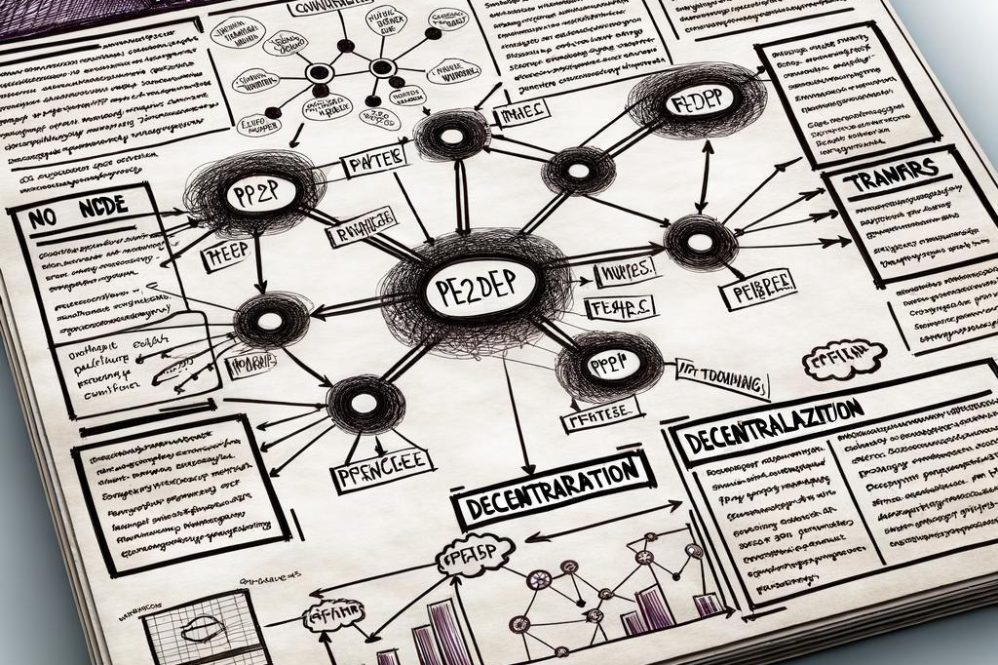
At its core, peer-to-peer (P2P) in the Bitcoin ecosystem means value and data flow directly between users and nodes without a trusted central intermediary. Bitcoin’s original design pairs a distributed network of nodes with decentralized consensus secured by proof-of-work, allowing wallets to broadcast transactions that propagate across the P2P topology and are eventually included in blocks. This architecture underpins features that matter to users and markets alike, including censorship resistance, global settlement finality, and the ability for anyone to run a validating node and independently verify the UTXO set. In practise, P2P manifests across multiple layers-from full nodes and light wallets to off-chain protocols-each trading off convenience, privacy, and trust assumptions.Key practical benefits include:
- Self-custody and sovereignty over private keys.
- Permissionless access to send/receive value globally without opening accounts.
- Resilience against single-point failures and third‑party outages.
moving from protocol to market, P2P shapes both retail and institutional behavior as the broader crypto market matures. Off-chain solutions such as the Lightning Network expand P2P payments capacity by enabling near-instant, low-fee microtransactions, while decentralized exchanges and protocols (e.g., trust-minimized markets and atomic-swap implementations) let counterparties trade without centralized custody. At the same time, institutional custody services and regulated venues have grown, so participants should understand the difference between custodial liquidity and pure P2P counterparty exposure. For newcomers, follow a stepwise approach to engage safely:
- Start small: practice with trivial amounts to learn wallet backup and transaction flows.
- Prefer hardware wallets and verify seed backups offline.
- Use escrowed P2P platforms or decentralized exchanges for larger trades and understand KYC implications under regimes such as the EU’s MiCA or ongoing U.S. enforcement actions.
understanding risks and measurable signals is essential for both newcomers and experienced participants. The April 2024 halving halved the block reward from 6.25 BTC to 3.125 BTC, reducing new issuance and altering miner economics-one of many on-chain drivers that can change fee markets and miner behavior. Monitor concrete metrics such as mempool size,average fees in satoshis/vByte,hash rate trends,and concentration of UTXOs or exchange inflows (on-chain exchange balances) to assess pressure points. Opportunities include using P2P rails to avoid custodial counterparty risk and to capture savings via Lightning micro-payments; risks include counterparty fraud on unescrowed trades, regulatory compliance exposure, and liquidity fragmentation. For experienced users: run a full node, use coin control and privacy-enhancing practices, and diversify execution across on-chain, lightning, and OTC P2P channels to manage execution costs and regulatory tradeoffs.

How P2P Networks Work: Nodes, Protocols and Data Flow
At the network level, Bitcoin operates as a distributed peer-to-peer (P2P) overlay in which independently operated computers-known as nodes-exchange messages and validate data according to a common rule set.Full nodes download and verify every block and transaction using the consensus rules in the protocol (for example, average block time ≈ 10 minutes and an effective throughput on-chain of roughly 3-7 transactions per second (TPS), depending on factors like SegWit adoption and transaction batching). In contrast, light clients (SPV) rely on full nodes for block headers and Merkle proofs. As validation is local and rule-based, running a personal full node is the strongest way to independently verify balances and maintain censorship-resistance; conversely, relying on custodial or hosted nodes trades that assurance for convenience. Importantly,the P2P layer implements a gossip protocol that propagates inventory messages (inv),transaction messages (tx),and block messages (block),so that new transactions enter the global mempool and travel across the topology until miners include them in blocks.
Following initial propagation, the flow from transaction broadcast to final settlement is governed by the fee market and consensus mechanics. When users broadcast a transaction it enters the mempool where miners prioritize by fee-per-byte and transaction age; during congestion the mempool can expand to hundreds of thousands of pending transactions and median fees can jump from single-digit sats/byte to the hundreds, underscoring how market demand influences on-chain cost. Miners package transactions into blocks and compete via proof-of-work-measured as network hash rate-to extend the longest valid chain; triumphant inclusion yields block rewards and confirmations that reduce the risk of reorgs. Transitionally,technologies like SegWit,batching,and layer-2s such as the Lightning Network materially change data flow and effective capacity: for example,higher SegWit usage (now well over majority adoption levels) reduces witness weight and lowers average fees for compatible transactions,while Lightning moves many low-value payments off-chain to preserve on-chain space for settlement and channel opens/closures.
For practitioners and newcomers alike, understanding the P2P data path yields concrete actions to improve security, cost efficiency, and privacy. To get started, consider these steps:
- Run or connect to a full node (pruned if disk space is a constraint) to validate rules yourself and avoid trusting third-party explorers.
- Use fee estimation and Replace-by-Fee (RBF) / Child-Pays-For-Parent (CPFP) strategies to manage confirmation risk without overpaying during spikes.
- Adopt SegWit addresses and batching where possible to reduce per-transaction fees and on-chain footprint.
For advanced operators, monitor network telemetry-mempool depth, orphan rate, hash rate trends, and fee distributions-to time large broadcasts, coordinate batch settlements, or optimize mining/relay policies. remain mindful of regulatory and custody developments (AML/KYC rules, ETF custody frameworks, and regional node-hosting guidance) that affect institutional behavior and, indirectly, network demand: while these trends present adoption opportunities, they also introduce compliance risk that node operators and market participants should plan for to preserve decentralization and long-term protocol health.
Real‑World Impact: Applications, Advantages and Key Challenges
Bitcoin today functions as more than a speculative asset; its technical design and growing infrastructure enable concrete, real‑world use cases that span payments, savings and cross‑border value transfer. Building on its peer‑to‑peer (P2P) architecture and the UTXO accounting model, on‑chain Bitcoin settlements continue to process hundreds of thousands of transactions daily, while layer‑2 protocols such as the Lightning Network enable near‑instant, low‑fee microtransactions for commerce and streaming payments. Moreover, institutional and retail adoption paths diverge: some users favor direct custody of Bitcoin for long‑term holding, while others interact with the broader crypto ecosystem via tokenized forms like WBTC to access DeFi lending and liquidity pools. In practice, P2P marketplaces and over‑the‑counter (OTC) desks provide vital fiat on/off ramps-reducing slippage for large orders and offering an option to centralized exchanges-so newcomers should evaluate the tradeoff between convenience of custodial services and the sovereignty of holding private keys themselves.
Equally crucial are Bitcoin’s concrete advantages, which explain persistent market demand and institutional interest. its fixed supply of 21 million and high liquidity underpin a market that frequently accounts for a substantial share of total crypto market capitalization (Bitcoin dominance has historically ranged between roughly 40-70%). Additional strengths include robust network security-evidenced by continually rising hash rate over multiple multi‑year cycles-divisibility down to satoshi units, and strong developer investment following upgrades like SegWit and Taproot. These qualities translate into practical benefits:
- Censorship resistance for cross‑border remittances and value preservation;
- Interoperability via wrapped tokens enabling collateralized lending and yield generation in defi;
- Low‑cost micropayments through Lightning that can unlock new business models and IoT billing.
For active traders and institutional allocators, actionable monitoring of on‑chain indicators-such as MVRV, realized cap, active addresses and exchange inflows-provides data‑driven context for positioning rather than relying on price noise alone.
However, the path to mainstream request is constrained by material challenges that both newcomers and veterans must manage. Scalability and privacy remain technical tradeoffs: while Lightning reduces fee pressure, it introduces liquidity management and routing risk; on‑chain transactions are secure but comparatively slower and costlier during congestion. Regulatory headwinds also affect utility and custodial choices-jurisdictions are increasingly imposing AML/KYC and reporting requirements, and frameworks such as the EU’s MiCA and ongoing enforcement actions elsewhere have shifted compliance burdens onto service providers. Consequently, practical steps include:
- For newcomers: prioritize a hardware wallet for long‑term holdings, practice seed‑phrase security, use dollar‑cost averaging to manage volatility, and prefer reputable on‑ramps that meet local compliance rules.
- For experienced users: run a personal Bitcoin node to verify transactions, consider multisig setups or professional custody for large allocations, use CoinJoin or other privacy tools judiciously, and route large trades through OTC desks to limit market impact.
In sum, Bitcoin’s real‑world impact is defined by a balance of proven technical strengths and evolving operational, legal and scalability challenges; informed participants can capture opportunities by combining sound operational security with ongoing monitoring of on‑chain metrics and regulatory developments.
as we’ve seen, peer-to-peer systems are less a single technology than a set of design choices: remove central chokepoints, distribute work and trust, and let participants talk directly. That architecture can make services faster,more resilient and frequently enough cheaper - but it also raises familiar trade-offs around security,privacy,governance and misuse.
For readers,the practical takeaway is twofold. First, match the P2P model to the problem: some tasks – content distribution, collaborative computing, censorship-resistant records – play to its strengths; others still need centralized control or hybrid designs. Second, treat P2P deployments with healthy scrutiny: assess threat models, verify code and incentives, and pay attention to evolving legal and regulatory contexts.
The headline for technologists, policymakers and everyday users alike is continuity: P2P thinking is shaping more of the internet’s future, from file sharing and messaging to cryptocurrencies and distributed services. Understanding its mechanics and limits lets you weigh its promise against its risks and make better decisions about when to adopt, adapt or regulate it.
If you want to dig deeper, follow reputable technical write-ups, security audits and policy analyses - and test ideas in controlled settings before scaling them.The decentralised web is no longer just a concept; it’s part of the infrastructure we all rely on. Knowing how it works matters.

