
The fundamentals of Entropy: Defining Disorder in Thermodynamic Systems
Entropy is fundamentally about measuring the level of disorder or randomness within a thermodynamic system. It quantifies the dispersal of energy and the number of ways a system can be arranged without changing its macroscopic properties. In thermodynamic terms,when energy is transferred,entropy tends to either increase or remain the same,corresponding to the second law of thermodynamics. This principle asserts that natural processes favor a direction towards greater entropy; for instance, ice melting in a warm environment illustrates a transition from a more ordered state to a more disordered one.
The concept of entropy applies to various systems, impacting phenomena including heat transfer and chemical reactions. Such as,when heat is added to a substance,molecules move more vigorously and become less structured,demonstrating an increase in entropy.In biological systems, entropy explains the inefficiencies in energy transfer, highlighting how organisms often must refuel to maintain order against the backdrop of increasing disorder in their surroundings.The ability to link entropy to real-world applications emphasizes its importance in understanding not only physical processes but also the functioning of living organisms.
Moreover, understanding entropy aids in recognizing the limits of energy systems, including engines and refrigerators. These devices operate under the principle that while it is indeed possible to convert energy from one form to another, some energy will invariably be lost as heat, resulting in increased entropy. As an inevitable result, engineers and scientists must continuously innovate to create more efficient systems that minimize energy losses and manage entropy effectively. The relationship between energy transitions and entropy illustrates a fundamental challenge: balancing the desire for energy efficiency wiht the inevitability of disorder that governs the physical universe.
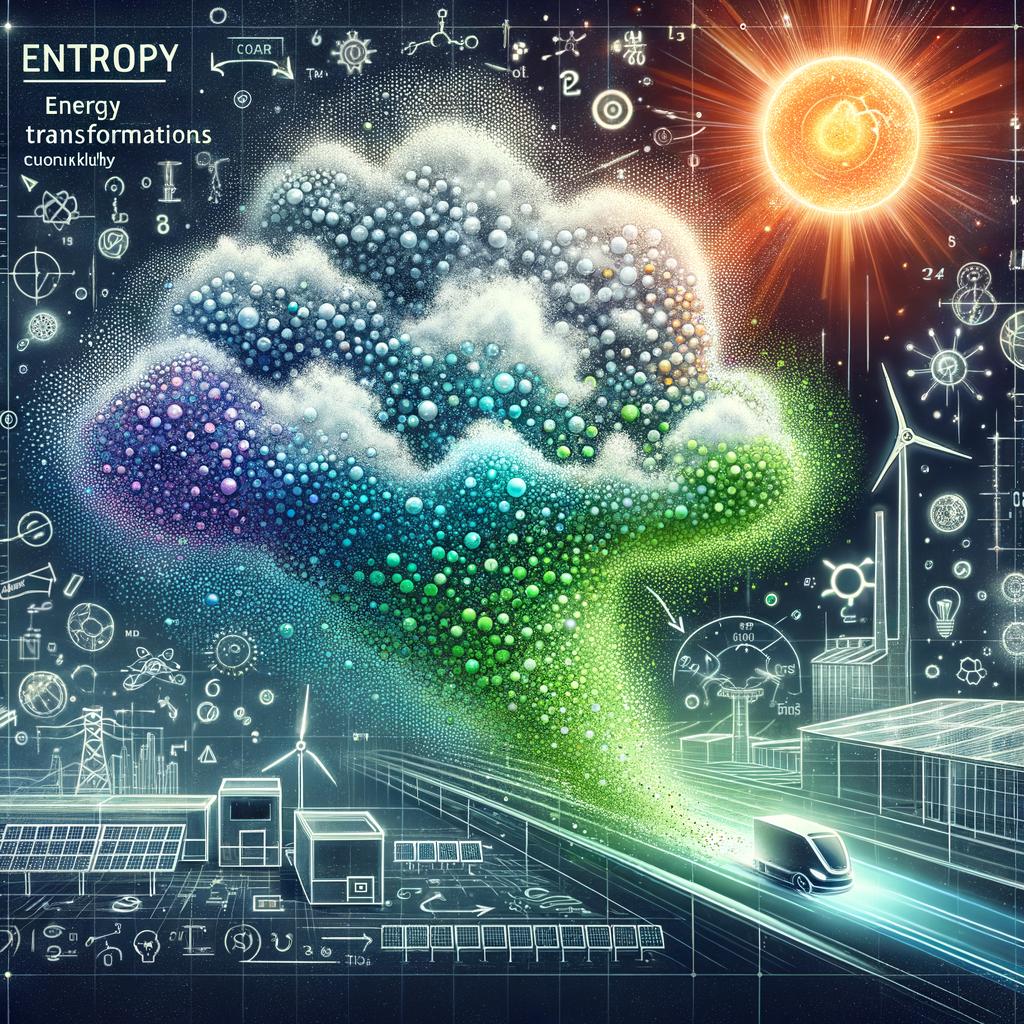
the Role of Entropy in Energy Transformations: Implications for Efficiency and Sustainability
Entropy plays a pivotal role in the transformation of energy,underscoring the inherent limitations imposed by thermodynamic laws. in any energy transfer or conversion process, such as combustion in engines or metabolic reactions in living organisms, some energy is invariably lost as unusable heat due to increasing entropy. This phenomenon illustrates the principle that energy systems naturally evolve towards greater disorder, leading to a decline in the availability of energy for work. As a result, understanding entropy is vital for optimizing energy efficiency in various applications.
When considering implications for sustainability, the notion of entropy drives home the importance of designing systems that minimize energy loss. In practical terms, this means enhancing the efficiency of energy transformations by using technologies that make better use of available energy. Some strategies include:
- Improving thermodynamic cycles in power plants to reduce waste heat.
- Implementing regenerative braking systems in electric vehicles to recapture energy.
- Advancing heat pump technologies that exploit low-grade heat sources.
moreover, the challenge of increasing entropy compels us to think critically about resource consumption and the lifecycle of energy products. As we grapple with climate change and resource depletion, recognizing the limits imposed by entropy guides innovations aimed at sustainable practices. Emphasizing renewable energy sources, which frequently enough have lower entropy production than fossil fuels, could lead to a significant decrease in overall entropy creation, thereby fostering a more sustainable relationship between energy consumption and environmental health.
From the Micro to the Macro: How Entropy Shapes Our Universe and Everyday Life
Entropy,often defined as a measure of disorder or randomness,plays a crucial role in the fundamental workings of our universe. At the microscopic level, it dictates the behavior of particles and molecules, influencing everything from chemical reactions to the stability of matter.For instance, when molecules in a gas spread out in a container, their arrangement transitions from a state of order to disorder, exemplifying an increase in entropy. This principle not only governs physical phenomena but is also foundational in the fields of thermodynamics and statistical mechanics, explaining why natural processes favor the spontaneous over the structured.
On a larger scale,the effects of entropy pervade our everyday lives. The gradual decay of buildings and the aging of materials underscore the inevitability of entropy at play.As time progresses, structures succumb to the elements, illustrating how high-entropy states become prevalent. This deterioration can be observed in various scenarios, such as the way food spoils or how energy dissipates in mechanical systems. The tendency for systems to evolve toward higher entropy highlights the challenges in preserving order in our bustling world.
Furthermore, entropy has profound implications for understanding the fate of the universe. As cosmologists explore the concept of heat death-a state where the universe reaches maximum entropy-they raise intriguing questions about the ultimate destiny of all matter and energy. This theoretical outcome suggests a future lack of available energy to perform work, signaling the end of stars, galaxies, and life itself. Such profound revelations not only reshape our understanding of cosmology but also remind us of the transient nature of all systems, pushing humanity to contemplate the balance between order and chaos in both the micro and macro realms.
the concept of entropy serves as a vital thread in the intricate tapestry of thermodynamics, illustrating how disorder and change are fundamental to the nature of energy and the universe itself. Recognizing the implications of entropy not only enhances our comprehension of physical systems-from the efficiency of engines to the complexities of biological processes-but also broadens our understanding of the entropy that governs daily life. As we continue to explore the role of entropy in various fields, we are reminded that even within the confines of scientific laws, there lies a beautiful chaos that drives the perpetual evolution of our world. Whether we are engineers, biologists, or simply curious minds, embracing the lessons of entropy can pave the way for innovations and deeper insights into the natural order. As we ponder the implications of disorder, we invite you to reflect on how these principles of thermodynamic change shape not just machines and organisms, but the very fabric of existence itself.