

What a $4 Trillion Tokenized Market Could Mean for Chainlink
Standard Chartered’s projection of a $4 trillion tokenized-asset market has put fresh attention on teh infrastructure needed to support on-chain finance. The estimate covers a broader market that includes stablecoins as well as tokenized real-world assets, such as funds, equities, credit products, and other financial instruments.
For Chainlink, the opportunity is not just tied to more assets appearing on blockchains. Institutions will need reliable data for those assets, along with ways to move information and value between networks. Chainlink’s oracle services and cross-chain tools are designed for those kinds of jobs, which is why the tokenized RWA growth story has become part of the long-term case for LINK.
In practical terms,tokenized assets may need verified pricing,proof-of-reserves information,and clear conditions before trades or collateral movements can be completed automatically. If institutions begin using tokenized products at meaningful scale, services that connect blockchains with trusted external data could see more consistent demand.
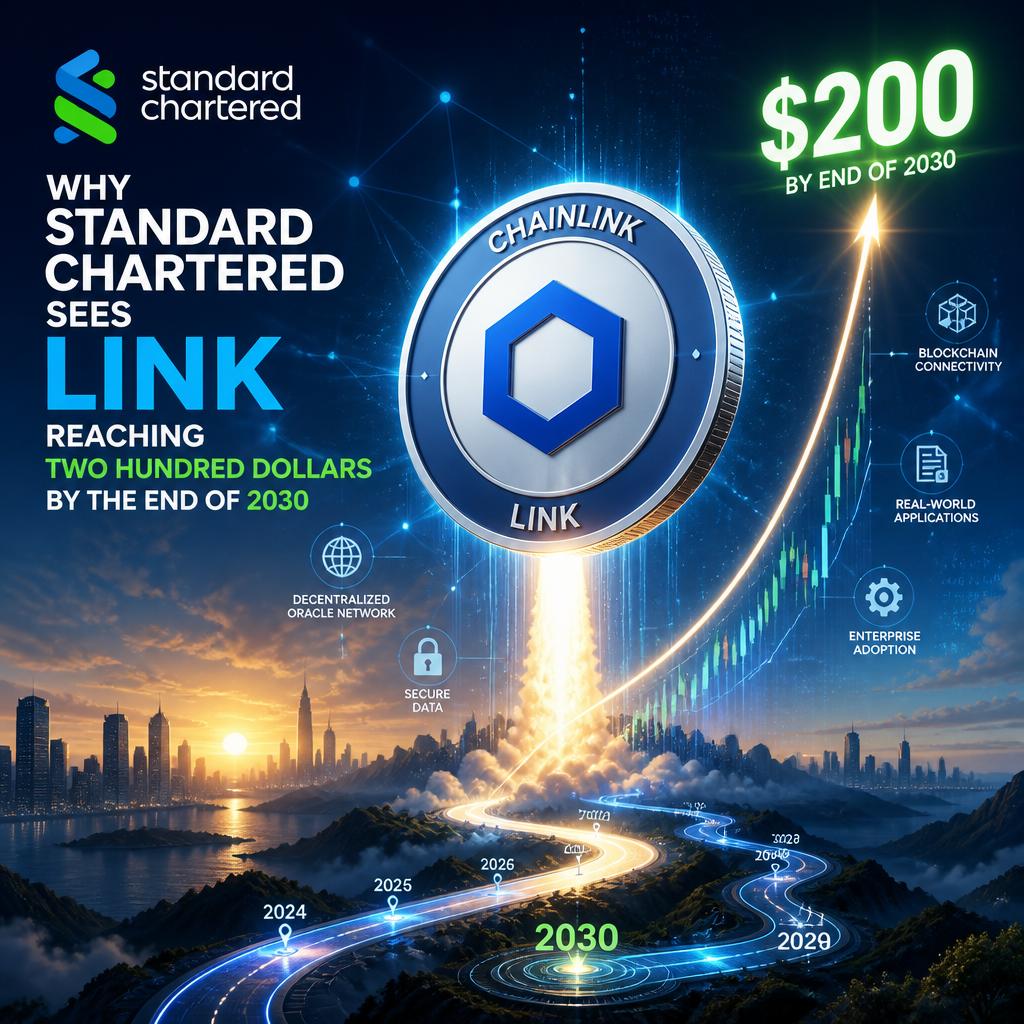
Why Standard Chartered Sees LINK at $200 by 2030
Standard Chartered’s bullish view on LINK is based on the expected expansion of on-chain financial markets rather than short-term price action. The bank projects tokenized assets could reach $4 trillion by the end of 2028, with stablecoins and tokenized real-world assets making up much of that market.
That backdrop could matter for Chainlink because tokenized funds, securitiesand other products are unlikely to exist in isolation on a single network. They may need current market data, verified information about the underlying assetsand a way to operate across different blockchains. If Chainlink becomes widely used for those functions, its network could play a larger role in the day-to-day workings of tokenized finance.
The $200 LINK target for the end of 2030 should still be viewed as a long-range scenario, not a certainty. Regulation, competition, market conditionsand the willingness of large institutions to move beyond small-scale pilots will all shape the outcome. But the core argument is straightforward: if tokenized real-world assets grow into a multi-trillion-dollar market,the need for trusted on-chain data and cross-chain connectivity could grow with it.
For investors, that makes LINK a bet on whether tokenization moves from promise to widespread use. A larger market alone would not guarantee a higher token price, but sustained institutional activity could give Chainlink a stronger foundation than speculation-driven demand alone.