
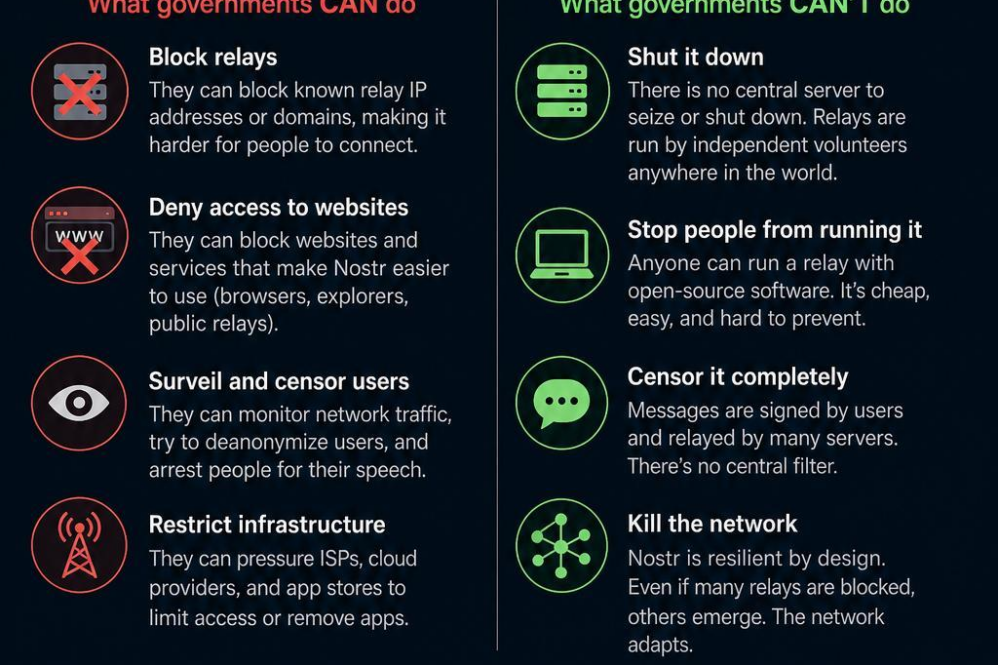
Governments face significant challenges when attempting to ban decentralized platforms like Nostr. Unlike traditional, centralized social media networks, Nostr operates without a central authority or servers, utilizing a distributed network of relays that anyone can run. This architecture inherently resists censorship,as there is no single point of failure or control that a government can target effectively.Attempts to impose bans would likely require blocking relay nodes individually, a strategy that is both technically impractical and prone to circumvention by users who can switch to choice, uncensored relays.
Key factors that complicate government bans include:
- Decentralization: No central server or controlling entity exists, making takedown efforts diffuse and ineffective.
- Redundancy: Multiple self-reliant relays ensure content availability even if some are blocked or shut down.
- Access flexibility: Users can run private relays or connect through any public relay, sidestepping restrictions.
- Open protocol: The open-source nature of Nostr allows for continuous adaptation and resistance against censorship tactics.
| Government Effort | Effectiveness | Challenges |
|---|---|---|
| Blocking IP addresses of relay servers | Low | Many relays, dynamic IPs, users can switch relays |
| Cracking down on client software | Minimal | Multiple open-source clients exist globally |
| Legal restrictions on users | Moderate | Difficulty enforcing across borders and privacy-preserving tools |
Ultimately, the resilience of Nostr stems from its foundational design of censorship resistance and peer-to-peer operation. While authoritative regimes may impose local restrictions or attempt user intimidation, completely banning Nostr across the internet is currently beyond the practical reach of governments.This creates an environment where free expression can thrive even under heavy surveillance and control measures.
Create your Nostr Profile