
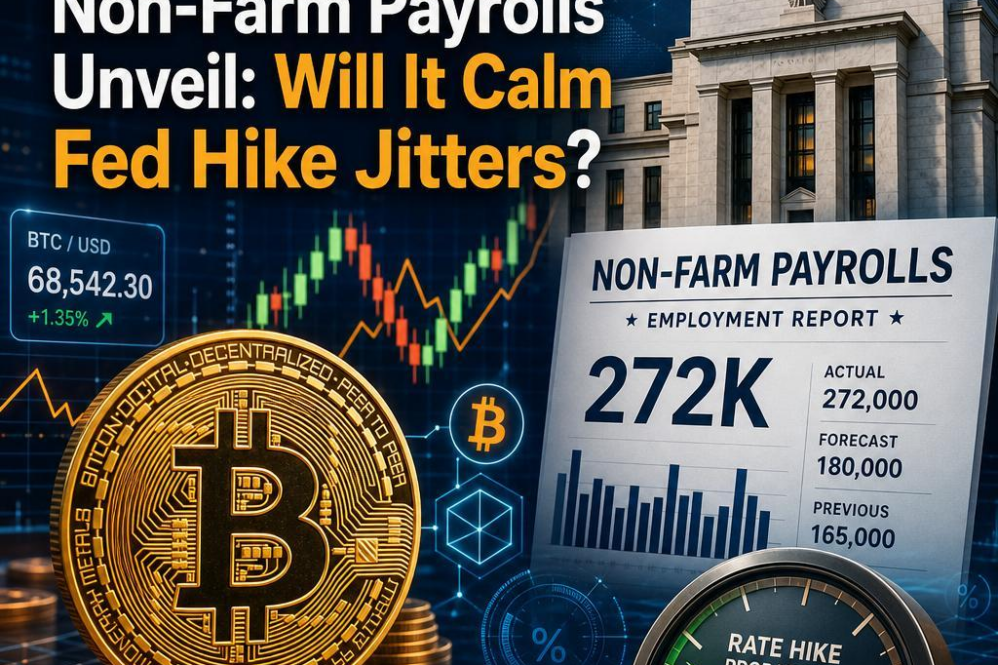
Bitcoin Price Trends Ahead of Non-Farm Payrolls
Bitcoin’s price movements in the lead-up to the release of the non-farm payroll (NFP) report are closely watched by market analysts and traders. The NFP report, which is released on the first Friday of each month, provides a extensive overview of the U.S. labor market by excluding government employees, private household members, and nonprofit organizations. This report is a key economic indicator that substantially impacts the U.S. dollar and,by extension,global financial assets like Bitcoin.
Analyzing Bitcoin’s price behavior before the NFP release can offer valuable insights into market sentiment and speculative trends. Typically, there is an increase in trading volume and volatility as traders adjust their positions based on anticipated economic data. This period frequently enough reflects the underlying sentiment and speculative bets on Bitcoin’s performance post-NFP. Though, the reactions to economic reports are not uniform and can vary based on the broader market conditions and the specific figures released.
The impact of the NFP report on Bitcoin is more nuanced compared to its influence on customary financial markets. For example, if the report indicates stronger-than-expected job growth, it could strengthen the U.S. dollar, possibly leading to a decline in Bitcoin prices as investors shift towards traditional assets. Conversely, weaker-than-expected figures might boost risk appetite, benefiting Bitcoin and other speculative assets. It is crucial to consider the broader economic context and market sentiments when interpreting the impact of the NFP report on Bitcoin.
The Impact of Non-Farm Payrolls on Federal Reserve Decisions
The non-farm payroll figures are a critical economic indicator that significantly influences the Federal Reserve’s decisions on interest rates. These figures provide a broad snapshot of the U.S. economy’s health by excluding agricultural employment. When employment figures rise, it can signal economic strength, potentially prompting the Federal Reserve to consider higher interest rates to control inflation. Conversely, a decline in employment figures might indicate a weakening economy, leading the Fed to lower interest rates to stimulate growth.
Understanding how these figures affect the cryptocurrency market requires a nuanced perspective. Higher interest rates can tighten liquidity and affect investor confidence and market sentiment. In the crypto space, these shifts can influence prices and trading volumes. Though, the precise impact is multifaceted and depends on various factors, including investor sentiment at the time of the announcement and the broader economic context.
While the Federal Reserve’s interest rate decisions have a meaningful impact on traditional markets, their influence on cryptocurrencies is more indirect. The challenge lies in interpreting the overall market reaction following the non-farm payroll release, as it involves assessing how investors respond to the data. This dynamic interplay means that while direct causation is not straightforward, the broader economic context and market sentiment play crucial roles in shaping the crypto market’s response.
Exploring the ripple effects from broader economic signals, such as non-farm payroll numbers, is essential for grasping short-term crypto market movements.
Navigating Bitcoin’s Volatility: Insights for Investors Before Major Economic Events
As the cryptocurrency market matures, Bitcoin investors face a landscape of uncertainty and opportunity. Major economic events, including central bank decisions and geopolitical shifts, highlight the asset’s volatility. Investors must remain vigilant, as these factors can significantly impact market sentiment and pricing.
Comprehending the potential influence of these events requires a refined approach. For instance, monetary policy changes can dramatically affect digital currency values. If a central bank tightens monetary conditions, it might strengthen the US dollar, potentially weakening Bitcoin and other cryptocurrencies. Conversely, a more lenient monetary policy stance could bolster the case for riskier assets, including Bitcoin.
Though, it’s vital to acknowledge that while economic events provide valuable context, they are just one part of the puzzle. Market behavior can be unpredictable,and speculative trading and market sentiment frequently enough complicate straightforward economic forecasts. Investors need to maintain a balanced view, considering a wide range of factors and staying informed about global economic trends.
The Interplay Between Employment Data and Cryptocurrency Markets: What to Anticipate
The relationship between employment data and cryptocurrency markets is a complex and dynamic interaction that can offer insights into broader economic conditions. Employment figures, such as the non-farm payroll report in the United States, are critical indicators of economic health. These reports can influence perceptions of economic strength or weakness, impacting investor sentiment and, consequently, the value of cryptocurrencies.
Cryptocurrency markets are highly sensitive to economic data that signals changes in economic activity, inflation, or interest rates. When employment figures suggest a robust economy, investors might view digital currencies as speculative plays or hedges against inflation. Conversely, weaker employment numbers or signs of economic downturn could prompt investors to reassess their portfolios, potentially leading to shifts in demand for cryptocurrencies. Though, it’s critically important to remember that cryptocurrency markets are influenced by a multitude of factors, not just employment data.
Understanding this relationship can help traders and investors make informed decisions, but it’s crucial to avoid over-reliance on a single data point. Economic indicators, including employment figures, provide context, but the volatile nature of the cryptocurrency market incorporates a wide array of variables, from regulatory developments to technological advancements. Investors would be wise to consider a comprehensive analysis of both macroeconomic trends and sector-specific developments to accurately gauge the potential impact on cryptocurrency markets.