

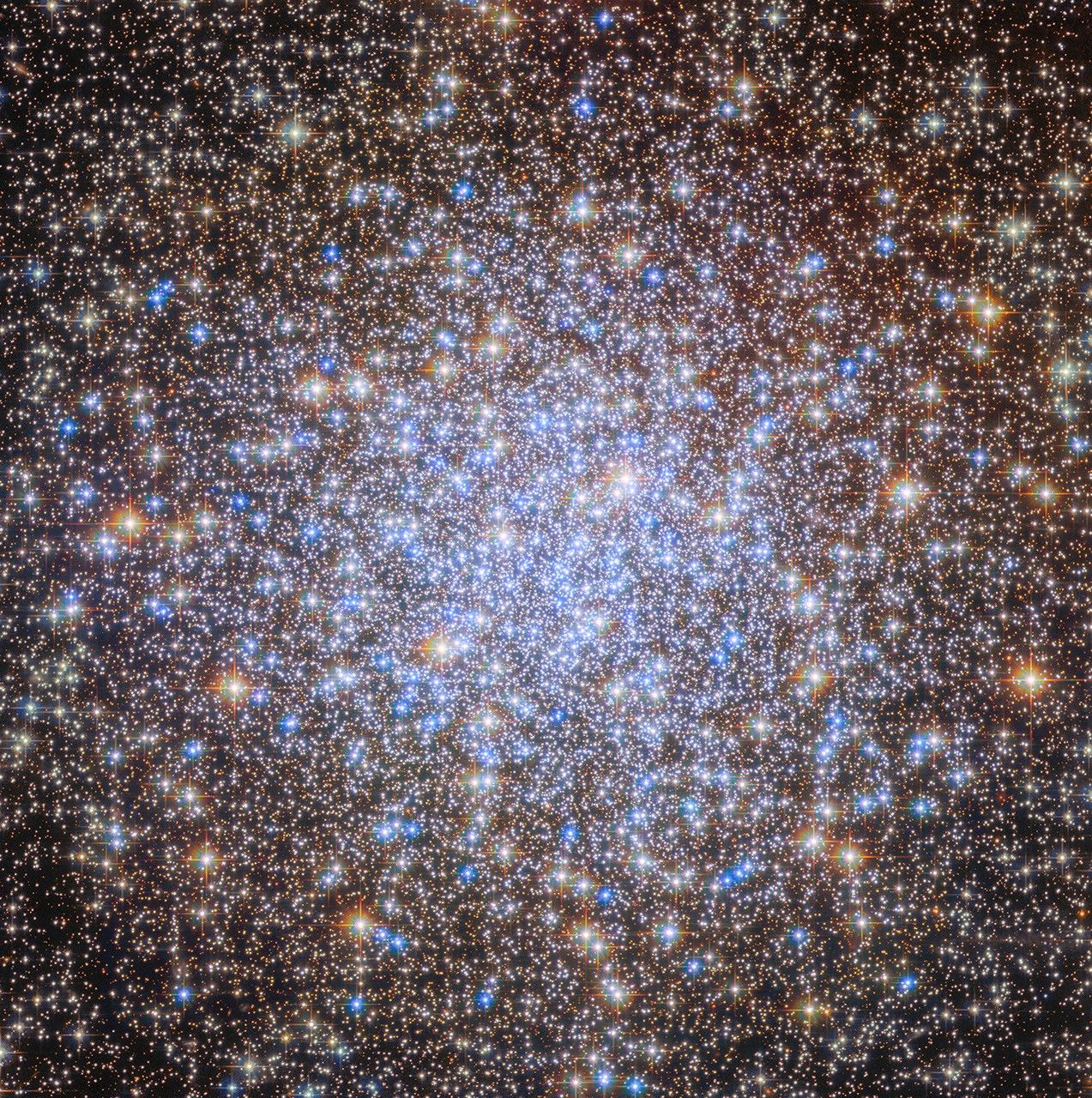
This image released on June 26, 2026, features the globular cluster NGC 6723, sometimes called the Chandelier Cluster. Like its namesake, it sparkles with countless lights. However, each ‘lightbulb’ in this chandelier is an individual star 27,000 light-years away in the constellation Sagittarius (the Archer).
Globular clusters like NGC 6723 contain some of the oldest stars in our galaxy. These clusters have ages that often exceed 10 billion years old, and some are nearly as old as the universe itself. Astronomers think globular clusters are some of the first structures that formed in our galaxy, coalescing potentially billions of years before the thin disk of stars in which our Sun orbits. The details of how globular clusters formed, however, are not yet certain.
Learn more about the Chandelier Cluster.
Image credit: ESA/Hubble & NASA, A. Sarajedini, G. Piotto
**Starry Chandelier Cluster Illuminates the Cosmos: A Detailed Look at NGC 6723**
*June 26, 2026 – NASA*
A newly released image showcasing the mesmerizing globular cluster NGC 6723, often referred to as the “Chandelier Cluster,” has captivated astronomers and space enthusiasts alike. Positioned approximately 27,000 light-years from Earth in the constellation Sagittarius-the Archer-this celestial formation sparkles with what appears to be countless twinkling lights. Yet, each of these radiant points is an individual star, offering scientists a unique window into the early universe.
### Background Context
Globular clusters are densely packed groups of ancient stars bound together by gravity. Containing hundreds of thousands to millions of stars, these clusters are among the oldest known objects in the Milky Way galaxy. NGC 6723 stands out not only for its impressive size and brilliance but also because it inhabits a relatively sparse region of space, providing a pristine environment for in-depth study.
This cluster’s nickname, the “Starry Chandelier Cluster,” is inspired by the delicate yet striking way it shimmers, evoking the image of an opulent chandelier adorned with countless glowing bulbs. Such visual comparisons help bridge the connection between astronomical phenomena and human experience, making the cosmos more accessible and intriguing.
### Key Details
– **Distance:** Approximately 27,000 light-years from Earth
– **Location:** Constellation Sagittarius (The Archer)
– **Composition:** Hundreds of thousands of stars, predominantly old Population II stars
– **Age:** Estimated to be over 10 billion years old, making it a relic from the early stages of the Milky Way’s formation
– **Observational Data:** The image was captured using advanced space-based telescopes equipped with high-resolution imaging technology, enabling detailed study of individual stars within dense stellar environments.
### Scientific and Market Implications
From a scientific perspective, examining clusters like NGC 6723 increases understanding of the Milky Way’s formation, stellar evolution, and the chemical enrichment of galaxies. Each star within the cluster serves as a data point to probe the conditions of the early universe and to refine models of star life cycles.
The detailed imaging technologies used to capture the “Starry Chandelier” also have broader market implications. Advances in telescope optics, imaging sensors, and data processing algorithms contribute to innovations in sectors such as medical imaging, remote sensing, and materials science. Commercial ventures related to space-based observation systems can leverage these technological developments to enhance their product offerings across industries.
### Expert Perspective
Dr. Elena Vasquez, an astrophysicist specializing in stellar populations at the Space Science Institute, remarks, “NGC 6723 is a stellar time capsule. By analyzing its stars’ composition and distribution, we gain critical insight into how the Milky Way assembled over billions of years. The quality of data we’re obtaining now marks a new era in globular cluster studies.”
She further notes, “The beauty of the ‘Starry Chandelier’ is not just in its visual appeal but in its scientific value. Each star is a beacon from the past, and together, they light the path toward a deeper comprehension of our cosmic origins.”
### Conclusion
The release of the breathtaking image of NGC 6723, the “Starry Chandelier Cluster,” underscores the blend of natural beauty and scientific intrigue that celestial phenomena offer. As technologies improve and data accumulates, clusters like this one will continue to illuminate not only the night sky but also the fabric of cosmic history.
For continued updates and detailed analyses, visit NASA’s official platform and affiliated scientific publications.
—
*Source: NASA; original article published June 26, 2026*
Read more at: https://thebitcoinstreetjournal.com/starry-chandelier-cluster/
Source: NASA