

Cryptocurrency has spent 15 years asking if regulators could catch up.
Markets in Crypto-Assets Regulation (MiCA), the landmark digital asset regulatory framework that goes into full effect across the European Union’s 27 member nations Wednesday (July 1), asks a different question.
Can crypto companies operate inside the financial system?
MiCA policy architecture does more than establish another licensing regime. It introduces a unified financial rulebook backed by regulators that have repeatedly emphasized there will be no extensions, no grace periods and no selective enforcement. It’s something crypto has rarely experienced at continental scale.
Spain’s securities regulator reiterated the message days before implementation, making clear that firms without authorization cannot simply continue operating while paperwork catches up.
Already, some of crypto’s most recognizable names are on the outs in Europe. Despite remaining the world’s largest crypto exchange, Binance failed to secure approval through Greece before the deadline and informed customers across several European markets that services would be suspended while it pursues authorization elsewhere. While other crypto exchanges, including MEXC, HTX and Bitfinex, have made no public announcements about their licensing successes or failures, the lack of communication is being taken as its own answer.
The real question, however, is no longer which companies survived licensing. It is what kind of crypto industry survives licensing. Throughout Europe, hundreds of small crypto businesses now face decisions that would have been almost unimaginable several years ago. They must obtain authorization, merge with licensed competitors, shrink operations or exit the market entirely.
Read also: MiCA’s Moment of Truth: Can Crypto Survive the Regulation It Asked For?
Who’s In and Who’s Out
MiCA is not merely licensing firms; it is actively restructuring market share. The visible story this week is that some firms received licenses while others did not. Collectively, regulators have approved roughly 200 crypto firms across the European Economic Area, although only around a dozen operate at meaningful exchange scale, Finance Magnates reported Thursday (June 25). Before MiCA took effect, there were more than 1,200 previously registered EU crypto businesses, meaning more than 80% of legacy operators failed to transition into the new regime.
The winners of Wednesday’s implementation include those exchanges and crypto service providers that secured authorization from European regulators and can now passport their licenses across the EU’s 27-member market. The licensing deadline is less of a compliance box-check and more of a market shakeout. Many firms that operated successfully under fragmented national registration systems are unlikely to survive the transition into a fully harmonized European framework.
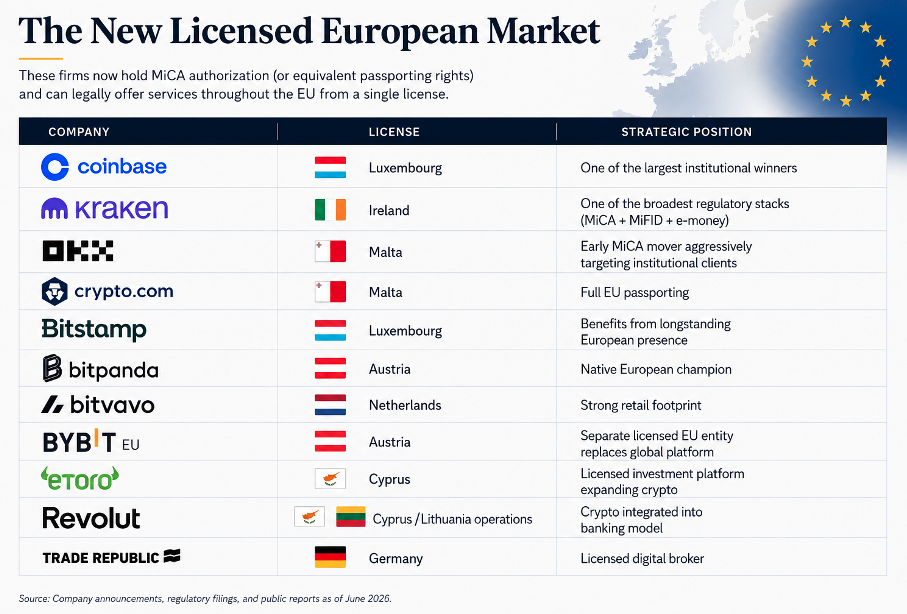
From a competitive perspective, the biggest immediate beneficiaries appear to be Coinbase, Kraken, OKX, Crypto.com, Bitstamp and Bitpanda, which now face less competition from unlicensed rivals while gaining seamless access to the entire European market. The result resembles traditional financial services, where regulation often raises barriers to entry while simultaneously increasing customer confidence.
USDT has effectively disappeared from regulated European exchanges because Tether chose not to seek MiCA authorization for its flagship stablecoin.
See also: Crypto Experts Tell PYMNTS Where Digital Assets Go Next
Europe and America Are Now Running Different Regulatory Experiments
The biggest misconception surrounding MiCA is that it represents crypto regulation.
It is better understood as financial infrastructure policy. As stablecoins increasingly facilitate cross-border payments, tokenized assets enter capital markets and blockchain settlement becomes integrated into treasury operations, regulators are treating crypto companies less like technology startups and more like providers of financial market infrastructure.
For 15 years, crypto’s defining competitive advantage was speed. Companies could launch globally before regulators had determined who supervised them. MiCA reverses that equation. The companies positioned to grow tomorrow are increasingly those capable of operating like regulated financial institutions today.
Banks, payment companies and large enterprises generally prefer predictable regulatory environments over regulatory flexibility. MiCA offers exactly that. Once authorized, firms gain access to the entire European single market through passporting rights rather than negotiating country-by-country approvals.
Meanwhile, across the Atlantic Ocean, the United States continues debating regulatory jurisdiction, congressional legislation and overlapping oversight among federal agencies. While Washington has made progress on stablecoin legislation and broader digital asset policy discussions, companies still face greater uncertainty than they do under Europe’s single rulebook.
The PYMNTS Intelligence and Citi report “Chain Reaction: Regulatory Clarity as the Catalyst for Blockchain Adoption” found that regulation will shape blockchain’s next leap.
Predictability could prove especially valuable as tokenized deposits, stablecoins, digital securities and institutional blockchain infrastructure continue expanding. Rather than competing primarily for retail traders, Europe may increasingly compete for institutional capital.
For all PYMNTS digital transformation coverage, subscribe to the daily Digital Transformation Newsletter.
The post Europe’s Crypto Reset Begins: Who’s In, Who’s Out Under MiCA appeared first on PYMNTS.com.
Source: PYMNTS |