

Can you turn your living room into a profitable Bitcoin mine? For many curious hobbyists and would‑be entrepreneurs, that question prompts an image of humming racks of machines and steady bitcoin payouts. The reality is more intricate. What once began as a decentralized experiment anyone could join with a home PC has evolved into a capital‑intensive,highly competitive industry dominated by purpose‑built hardware,economies of scale,and razor‑thin margins.
This article untangles the myths and metrics behind home Bitcoin mining. we’ll explain how mining works in plain terms, show how the shift from CPUs and GPUs to ASICs has altered the economics, and highlight the hard costs – electricity, equipment, cooling, and network fees – that determine whether a setup is viable. We’ll also examine non‑financial realities: noise, heat, regulatory and contractual issues with landlords or utilities, and the environmental footprint of continuous power consumption.
Drawing on industry interviews, real‑world case studies, and profitability frameworks, we’ll walk readers through the calculations and decisions that matter: when home mining might make sense, when its effectively a hobby, and when it’s simply not worth the expense. If you’re weighing whether to plug in a miner at home, read on for the costs, tradeoffs, and unvarnished realities behind the digital goldrush.
Understanding Bitcoin Mining: How proof of Work Powers the Network
Proof-of-work is the engine that underpins every confirmation on the Bitcoin ledger: miners race to find a cryptographic nonce that produces a hash meeting a target difficulty, and the first to succeed earns the right to append a block. This process both orders transactions and mints new coins, but it’s not a matter of luck alone – raw computational power and efficient hashing hardware determine who wins in the race, making the protocol intentionally resource-intensive to secure the network.
The system’s security hinges on the relationship between total network hash rate and mining difficulty. As more hashing power joins the network, the protocol automatically elevates the difficulty so that block intervals remain steady. that feedback loop makes attacks prohibitively expensive: an adversary would need to control a majority of the network’s hashing capacity, which means accumulating enormous compute resources and energy.
Energy consumption and cost structure are the practical barriers that distinguish hobbyist miners from professional operations. Modern Bitcoin mining favors the latest ASICs (Request-Specific Integrated Circuits) that deliver the best joules-per-hash; attempting to compete with older or general-purpose hardware at home quickly becomes uneconomic. Beyond hardware, electricity price, cooling, and maintainance are recurring line items that erode margins – and these are the realities that determine whether a home setup breaks even or bleeds cash.
The decision to mine at home depends on a handful of real-world variables. Consider:
- Electricity rate: the single biggest ongoing cost.
- Hardware efficiency: measured as watts-per-terahash (W/TH).
- Pool participation: joining a pool smooths rewards but incurs fees.
- Physical constraints: noise, heat, and ventilation needs.
| Metric | Typical Home Setup | Industrial farm |
|---|---|---|
| Hashrate | Low – single ASIC(s) | Very high - racks of ASICs |
| Power | 1-5 kW | MW-scale |
| noise & heat | Loud, confined | Managed with industrial cooling |
| Capital Cost | Low-moderate | High (infrastructure) |
Incentives align miners’ behavior with network health: block rewards and transaction fees compensate for expense and risk, and scheduled halving events progressively reduce subsidy, making efficiency and cost-management ever more critical. for most individuals, joining a mining pool or investing indirectly (via ETFs, stocks, or hosting services) will be the more pragmatic choice; solo mining at home remains technically possible but statistically unlikely to yield meaningful returns without unusually low power costs or access to cutting-edge hardware. Ultimately,proof-of-work keeps bitcoin secure – but it also sets a high bar for anyone hoping to profitably operate at a domestic scale.
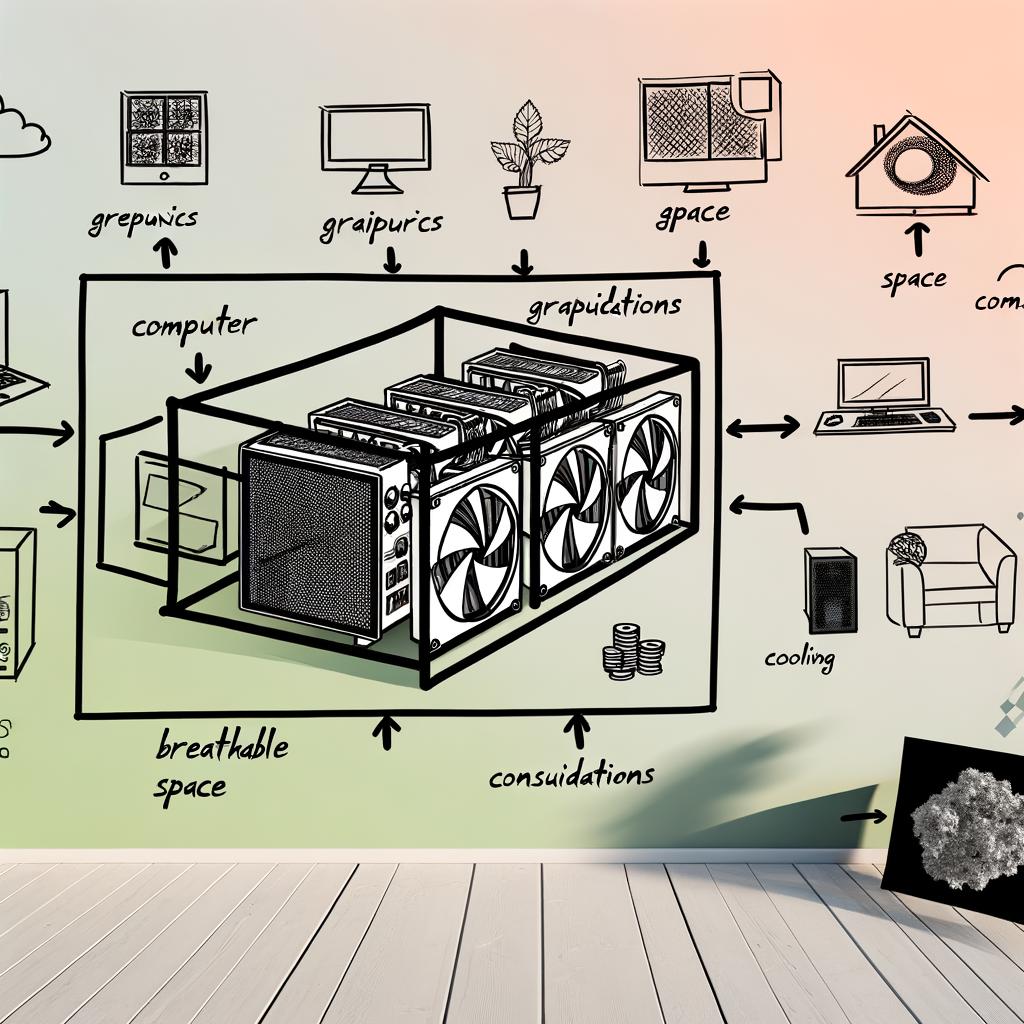
Home Mining Setup: Required Hardware, Space and Cooling Considerations
Essential hardware for a viable home rig starts with one or more ASIC miners – purpose-built machines that crush CPU/GPU rigs for Bitcoin today – paired with a high-efficiency power supply, a reliable router or switch, and a monitoring device (laptop or small single-board computer). Don’t forget basic accessories: heavy‑duty power cables, appropriately rated breakers, and a small tool kit for mounting and maintenance. For redundancy,consider a UPS for safe shutdowns and a surge protector to protect sensitive electronics.
Space planning is more than square footage; it’s about locating equipment where heat, noise and vibration won’t disrupt daily life. Choose a ventilated, non‑carpeted room with concrete or tiled floors if possible, away from bedrooms and living spaces. Account for clearance around each unit (at least 30-60 cm) for airflow and service access, and verify that the floor and shelving can handle concentrated weight from racks of miners.
- Checklist: dedicated circuit, ventilation path, noise insulation, fire extinguisher
- Measure ambient temp and humidity before installation
- Plan cable runs for minimal tripping and heat buildup
Cooling is the linchpin of stable operation. Small desktop fans may suffice for a single unit, but sustained mining at scale requires targeted airflow management: intake and exhaust fans, ducting to move hot air outdoors, or integration with existing HVAC systems. Remember that cooling choices change operating cost: active cooling raises electricity draw but prevents costly hardware failures and throttling that reduce hash rate.
Electrical safety and capacity are non‑negotiable. Many home circuits are not designed for continuous 24/7 loads at the levels miners demand. Consult an electrician to install a dedicated circuit with proper amperage and wiring. The table below offers a speedy comparison of typical miner specs to illustrate why proper power planning matters.
| model (example) | Hashrate | Power (W) | Daily kWh |
|---|---|---|---|
| AntMiner X (small) | 40 TH/s | 3,200 W | 76.8 |
| Mini ASIC | 10 TH/s | 1,200 W | 28.8 |
| Legacy Unit | 5 TH/s | 1,000 W | 24.0 |
Operational realities often determine whether home mining is sensible: persistent noise, higher electricity rates, and potential landlord or HOA restrictions can erode returns. For enthusiasts, start with one machine and monitor power draw, noise and local temperature for a few weeks. Consider pooling or cloud/mining services if scale, cost or space make self‑hosting impractical – and always document installations for insurance and safety compliance.
Energy Costs and Profitability: Calculating Realistic Returns for Home Miners
Electricity is the single largest variable that determines whether a home Bitcoin operation is a hobby expense or a small business. Even modest ASIC rigs draw kilowatts of continuous power; at mainstream retail rates, that converts into dozens of dollars per day just to stay online. Studies on energy-hungry technologies – from data centers to generative AI - underscore the same truth: efficiency and sourcing of power shape both balance sheets and environmental footprints.
Hardware efficiency is what separates theoretical revenue from real profit. Miners are routinely measured in hash rate (TH/s or PH/s) and watts consumed, and the combined metric-Joules per terahash (J/TH)-is the practical benchmark. For Bitcoin today, profitable setups are almost always ASIC-based; consumer GPUs that once chipped away at altcoins now produce negligible bitcoin returns and consume disproportionate power.
To illustrate how energy eats into returns, consider this simple, illustrative example. Numbers are rounded and should be plugged into an up-to-date calculator for accuracy, but the pattern is instructive: high continuous power multiplied by a non-trivial price per kWh quickly outweighs nominal daily BTC payouts.
| Device | Hashrate | Power (W) | kWh/day | Electricity/day (@$0.15) | Revenue/day (est.) | Profit/day |
|---|---|---|---|---|---|---|
| Old ASIC (illustrative) | 100 TH/s | 3200 | 76.8 | $11.52 | $9.00 | -$2.52 |
| Efficient ASIC (illustrative) | 100 TH/s | 3000 | 72.0 | $10.80 | $9.00 | -$1.80 |
| GPU Rig (not ideal for BTC) | ~0.5 TH/s | 1200 | 28.8 | $4.32 | $0.05 | -$4.27 |
Lowering energy spend is the only lever most home miners can realistically pull. Practical tactics include:
- Time-of-use billing: shifting workloads to off-peak hours where available;
- Renewables pairing: pairing solar/storage to offset daytime draw or sell surplus back to the grid;
- Pooling: joining a mining pool stabilizes payouts and reduces variance;
- Efficient cooling: reclaiming waste heat or using passive cooling to lower ancillary electricity use.
Energy is only one piece of the profitability puzzle-capital expenditure, amortization, repair, noise mitigation and local regulations matter to. When you factor in hardware depreciation (ASICs can age rapidly as new models improve J/TH), even seemingly small daily losses compound into a short or negative payback period.
Do the math before plugging in a rig: run multiple scenarios with current BTC prices, network difficulty, and your actual kWh rate, and include a conservative lifespan for the hardware. Tools and calculators can definitely help, but remain skeptical of glossy ROI tables – realistic returns are driven by energy price, device efficiency, and market volatility. Consider also community and environmental costs highlighted in broader energy debates; mining at home might potentially be possible, but profitable and responsible? That answer depends largely on the numbers behind your meter.
Alternatives to Solo Mining: Mining pools, Cloud Mining and Their Tradeoffs
Mining pools transformed Bitcoin mining from a lottery into a predictable income stream for small-scale operators. Rather of waiting years for a solo block reward, home miners can contribute hashpower to a pool and receive frequent, proportional payouts. that reliability comes at a cost: pools charge fees, enforce payout minimums, and can concentrate hashpower – a systemic tradeoff between steady returns and decentralization.
Joining a pool reduces variance but introduces counterparty risk.Pools coordinate block-finding and distribute rewards; if a pool operator is malicious, inefficient, or suffers downtime, contributors lose earnings. Typical tradeoffs to weigh include the pool’s reputation, fee schedule, server latency for your rig, and how often the pool pays out. For many hobbyists, the convenience of pooled payouts outweighs these risks.
Cloud mining promises zero hardware headaches: you rent hashrate and let someone else run the equipment. The appeal is obvious for non-technical buyers, but the reality frequently enough diverges from marketing. Contracts may lock you into fixed payments, be eroded by rising network difficulty, or contain hidden maintenance and electricity fees; plus, the space has been plagued by fraud and opacity. For anyone evaluating a provider, contractual transparency and verifiable mining addresses are essential red flags.
Different payout and contract models shift risk in predictable ways. Common structures include:
• PPS (Pay Per Share) – steady, lower variance but higher fees; • PPLNS (Pay Per Last N Shares) – rewards long-term contributors, more variance; • FPPS (Full pay Per Share) – includes transaction fees in payouts. Each model alters how volatility,luck,and operator margins affect your bottom line.
Beyond payouts, practical tradeoffs matter for home setups: running your own ASICs means full control over firmware, resale value, and tax treatment, but also responsibility for cooling, noise, and electricity. pooling shares responsibility for block finding but not for the capital depreciation of your hardware; cloud contracts shift capital expense to the provider but can lock you into poor returns as network difficulty climbs.
For readers deciding what to do at home, consider your aim: if you want a learning project and retain control, small-scale solo or pool participation makes sense; if you want passive exposure without hardware, carefully audited cloud contracts might work for short horizons. Prioritize transparent fee schedules, known payout schemes, and realistic break-even calculations – and remember that commitment to any path requires monitoring Bitcoin’s difficulty, price, and your local power economics.
Regulatory, Safety and Noise Concerns for Home Mining Operations
Local rules can be surprisingly decisive: many municipalities and homeowners associations treat sustained, high-power computing setups as a commercial activity. That can trigger zoning reviews, require business registration, or run afoul of utility terms of service. Make inquiries early – ask your city building department about electrical permits and your HOA about visible equipment and external vents – because noncompliance can led to fines, forced removal, or utility service changes that wipe out any short‑term mining gains.
Electrical risk is the most immediate safety concern. Consumer-grade wiring and shared circuits were not designed for continuous, high-AMP loads; overloaded circuits increase the chance of tripped breakers, damaged equipment, and fire. Installations should include a dedicated circuit, professionally sized breakers, proper grounding, and surge protection. Regular inspections,tidy cable management,and basic fire suppression readiness (rated extinguishers,functioning smoke detectors) are non-negotiable.
Noise from ASIC rigs and cooling fans is more than an irritation - it’s a social and regulatory headache. Typical miners can produce sustained noise levels of 60-80 dB (comparable to a busy street), which can breach local noise ordinances or provoke neighbor complaints. Track decibel levels, avoid placing rigs in shared walls or living spaces, and be mindful of time-of-day rules; persistent disturbances frequently enough attract official complaints faster than any technical violation.
Insurance and liability often get overlooked. Many homeowner policies exclude coverage for business activities or equipment run for profit; a claim involving mining gear could be denied if an insurer deems the operation commercial.Notify your insurer if you plan to run multiple rigs; failure to disclose can void coverage. Also consider how mining may affect taxes and resale value – documented proof of energy usage,expenses,and safety measures will help if questions arise.
- Checklist for responsible home mining: confirm zoning/HOA rules, secure a dedicated circuit, schedule an electrical inspection, notify your insurer, monitor noise levels, and document energy consumption.
- Alternatives to reduce risk: colocate with a miner-friendly host, rent cloud hashing power, or join a community data center.
Mitigation is practical and usually a mix of engineering and paperwork: sound-damping enclosures, remote monitoring, heat recovery (routing exhaust to heat water or a workshop), and time-of-use strategies to avoid peak tariffs. For many hobbyists the reality is that the cumulative regulatory, safety, and noise costs - plus the administrative burden of permits and insurance disclosures – will push them toward hosted or commercial solutions. If you proceed at home, treat it like a small industrial setup: document everything, engage professionals, and expect periodic scrutiny.
| Risk | Simple Mitigation |
|---|---|
| Overloaded circuits | Install dedicated circuit; electrician inspection |
| Fire hazard | Smoke detectors; rated extinguisher; tidy cabling |
| Noise complaints | Acoustic enclosures; relocate to basement/garage |
| Insurance denial | Disclose activity; adjust policy or add rider |
Cost Saving Strategies and Energy Optimization for Home Miners
Start with the math. Audit your baseline consumption using a smart meter or plug-level wattmeter and compare that with your utility’s tariff structure-look for time‑of‑use rates, off‑peak windows and demand charges.Small home rigs can be viable only when power price per kWh and the rig’s watts-per-hash are aligned; a clear, month-by-month energy spreadsheet is the first defense against surprise losses.
Choose hardware and settings that maximize hash per watt. Newer ASICs and properly tuned gpus often deliver better long‑term economics than older, high-power units. Focus on efficiency metrics (W/TH or W/MH), apply conservative undervolting and clock adjustments, and avoid pushing hardware to unstable extremes that shorten life span and raise replacement costs.
Optimize the physical environment to cut cooling costs. Passive ventilation, targeted fans, and insulated exhaust paths can lower ambient temperatures and reduce fan power draw. Consider beneficial reuse of waste heat-routing exhaust to warm a garage,preheat domestic water,or feed a greenhouse can offset household energy use and materially improve the mining-to‑home energy equation.
Leverage monitoring and notification tools for continuous control. Remote alerts via email and smartphone let you react fast to outages or thermal events; set up instant notifications through your Gmail account and pair them with mobile apps on Android for push alerts and device tracking. Automated scripts can pause rigs during peak-price windows and restart them when rates fall, turning manual oversight into programmatic savings.
Practical steps that pay off quickly:
- Shift load to off‑peak hours where possible (cron jobs or scheduler scripts).
- Join a mining pool to smooth revenue and reduce wasted shares from intermittent uptime.
- Batch maintenance to minimize downtime and avoid repeated power cycles.
- Reuse heat to displace other home heating loads.
- negotiate or switch to a lower tariff if your consumption profile justifies it.
| Measure | Typical Cost | Estimated Monthly Saving |
|---|---|---|
| Smart plug + scheduler | $30-$60 | $10-$40 |
| Efficient ASIC swap | $500-$2,000 | $50-$200 |
| Heat reuse (plumbing/ducting) | $0-$300 | $20-$100 |
Bottom line: disciplined monitoring, efficient hardware, and creative heat reuse can tip marginal home mining from loss to break‑even in the right markets; treat every watt as a line item and prioritize measures with the shortest payback.
Is Home Bitcoin Mining Worth It Today: Practical Recommendations for Prospective Miners
Home mining today is no longer the hobbyist-friendly pursuit it once was; the network hashrate and professionalization of the industry mean individuals face steep hurdles to profitable operation. Expect intense competition from large-scale farms, rising difficulty adjustments, and diminishing block rewards relative to total network power. That reality makes careful numbers-electricity, hardware amortization, cooling, and pool fees-non-negotiable before committing capital.
Upfront hardware remains the clearest gatekeeper. Modern ASICs deliver the only viable hash-per-watt for Bitcoin, but they are costly, noisy, and have finite lifetimes. Below is a quick snapshot of representative devices to illustrate scale and trade-offs.
| Model | Hashrate | Power | Approx. Price |
|---|---|---|---|
| Entry ASIC | 50 TH/s | 2400 W | $800 |
| Mid-range | 100 TH/s | 3000 W | $1,800 |
| Top-tier | 300 TH/s | 3250 W | $6,000+ |
Operational costs are where many projects fail. Electricity is the dominant recurring expense; at residential rates above $0.10-$0.12/kWh, break-even windows lengthen dramatically. Maintenance, replacement parts, and internet uptime add ongoing overhead, while heat and noise can make home operation untenable in apartments or shared housing.
- Electricity rate: Most important variable for profitability
- Pool membership: Reduces variance but introduces fees
- Cooling & ventilation: Hidden costs and neighbor impact
- Resale value: ASICs depreciate rapidly – plan for disposal
practical recommendations: if you can access sub-$0.06/kWh power,have space for equipment with adequate ventilation,and accept long payback periods,running a single unit can be a learning experience and modest revenue stream. Or else,consider alternatives: join a reputable mining pool,invest in publicly traded mining companies,or explore cloud mining contracts only after diligent vetting. Diversify risk-don’t allocate savings solely to hardware hoping for short-term windfalls.
treat mining as both a technical and regulatory exercise. track local regulations, register business activity if required, and keep accurate records for taxes. Run sensitivity analyses with conservative Bitcoin price and difficulty scenarios, and prepare an exit plan for underperformance. With realistic expectations and disciplined cost control, prospective miners can decide whether to build, buy, or walk away-each choice has clear, measurable trade-offs.
Q&A
Note: the web search results you provided returned unrelated Google support pages, so the Q&A below is based on widely known facts about Bitcoin mining rather than those search links.
Title: Can You Mine Bitcoin at Home? Costs and Reality – Q&A
Q1 – What is Bitcoin mining in simple terms?
A1 – Bitcoin mining is the process that secures the Bitcoin network and issues new bitcoin. Miners run specialized hardware to solve cryptographic puzzles; the first miner to find a valid solution adds the next block of transactions to the blockchain and earns a block reward plus transaction fees.
Q2 – Can an ordinary person realistically mine Bitcoin at home today?
A2 – Technically yes, anyone can attempt to mine at home. Practically, solo home mining with consumer electricity and a single machine is unlikely to be profitable against industrial operations that use many high-efficiency ASIC miners and low-cost power. Most home miners join pools or mine other coins and convert proceeds to BTC.
Q3 – How has mining hardware evolved?
A3 – Early Bitcoin mining used CPUs, then GPUs, then FPGAs, and now ASICs (application-specific integrated circuits) designed solely for SHA-256 (Bitcoin’s algorithm). Modern ASICs deliver far higher hashrate per watt than consumer hardware; that efficiency advantage is why industrial-scale mining dominates.
Q4 - What are the main costs of mining at home?
A4 – Key costs:
- Hardware: one or more ASICs (thousands of dollars each for new, less for used).
- Electricity: continuous power draw measured in kW; usually the largest ongoing expense.
- Cooling and ventilation: fans, possibly HVAC upgrades.
- Internet and space: stable connection and a secure, dry area.
- Maintenance and replacement: fan wear,power supplies,hardware degradation.
- Pool fees, mining software, and taxes.
Q5 – How do I know if mining will be profitable for me?
A5 – Use a mining profitability calculator. Inputs: your miner’s hashrate and power consumption, electricity price (per kWh), pool fees, current Bitcoin price, and current network difficulty or total network hashrate. Profitability equals the bitcoin earned minus electricity and operating costs. As difficulty and price fluctuate, profitability can change rapidly.
Q6 – What electricity price makes home mining feasible?
A6 – There’s no worldwide cutoff, but a rule of thumb: residential rates above roughly $0.04-$0.06 per kWh make it very difficult to be profitable with modern ASICs unless you have exceptionally efficient hardware or other advantages. Many home miners find profitability challenging at typical household rates ($0.10-$0.20+/kWh).
Q7 – What about noise, heat, and safety concerns?
A7 – ASIC miners are loud (often comparable to a small vacuum or hairdryer) and generate significant heat. They require proper ventilation and can raise fire risks if not installed and maintained properly. Noise and heat make them impractical for many living spaces.
Q8 – Should I mine solo or join a pool?
A8 – Most home miners join pools. Solo mining yields highly variable and very infrequent rewards unless you control a large share of the network hashrate. Pools provide steadier, proportional payouts but charge small fees.
Q9 - Are second‑hand ASICs a good option for home miners?
A9 – Buying used ASICs can lower upfront cost but carries risks: reduced lifespan, missing warranties, shipped wear and tear, and potentially obsolete efficiency compared to newer models. Factor in remaining life, power draw, and resale value.
Q10 – Are there alternatives to mining Bitcoin directly at home?
A10 – Yes:
- Mine other, GPU-friendly coins and convert rewards to bitcoin (but these coins have different markets and risks).
- Use cloud mining contracts (high risk: many providers are scams or unprofitable).
- Buy bitcoin directly or invest in mining stocks/funds.
- Participate in small-scale renewable projects paired with mining where legal and practical.
Q11 – What environmental impact should I consider?
A11 – Bitcoin mining consumes significant electricity. The carbon footprint depends on the energy mix; miners using coal-heavy grids increase emissions, while those using renewable or stranded energy reduce net emissions. Environmental concerns are central to the public debate around mining.
Q12 – How do protocol changes and halvings affect profitability?
A12 – Bitcoin’s block reward halves approximately every four years; the most recent halving reduced new issuance, lowering the bitcoin reward per block. That makes mining revenue per unit of work lower unless price or transaction fees rise to compensate. Difficulty adjusts with network hashrate; more miners typically push difficulty up, reducing per-miner yield.
Q13 – What legal or tax issues should home miners know?
A13 – Mining income is usually taxable where you live; rules vary by country. Utilities and zoning regulations may restrict noisy, high-power equipment in residences. Always check local laws, utility policies, and tax obligations before starting.
Q14 – If I want to experiment, how should I start?
A14 – Start small and treat it as a learning project:
- Research current ASIC models and expected power draw and hashrate.
- Join a reputable mining pool.
- Calculate expected returns with conservative estimates.
- Consider testnet or GPU mining on less competitive coins first.
- Monitor temperatures,electricity usage,and noise; ensure safe power setups.
- Keep records for tax reporting.
Q15 – Where do most home miners succeed or fail?
A15 – Success factors: access to very low-cost electricity, highly efficient hardware, or being in a niche with special energy access (e.g., on-site renewables or excess/stranded energy).Failures often come from underestimating electricity costs, ignoring equipment wear, buying over-priced or inefficient hardware, or relying on optimistic price forecasts.
Q16 - Bottom line – is home Bitcoin mining a reasonable pursuit?
A16 – For most people with typical residential electricity and living conditions, home Bitcoin mining is unlikely to be a reliable profit source in 2024-2025. It can be a worthwhile educational project or hobby if you accept the costs, noise, and risks. Profitability requires careful calculation, access to low-cost power, efficient hardware, or a strategy that offsets those disadvantages.
If you want, I can:
- walk through a sample profitability calculation using your local electricity rate and a specific miner model.
- Provide a checklist for a safe home setup.
- Summarize current miner models and their typical specs (hashrate and power).
Closing Remarks
As the dust settles on the technical specs and balance-sheet math, the practical answer is clear: home Bitcoin mining is possible, but for most individuals it is neither simple nor reliably profitable. Up‑front hardware costs, rising network difficulty, and the steady drain of electricity turn what once was a hobbyist pursuit into an industrial-scale contest. Only those with access to low electricity rates, the ability to manage heat and noise, and the appetite for ongoing maintenance and hardware turnover stand a real chance of breaking even – and even they face market and regulatory risks.
For casual participants, pooling resources through a mining pool can smooth out reward variability, but it does not eliminate the underlying cost and competition pressures. Alternatives such as buying Bitcoin directly, using custodial or noncustodial wallets, or exploring proof‑of‑stake and other crypto projects may offer simpler and more capital‑efficient exposure to crypto markets.
Before you decide,run the numbers: compare equipment amortization,electricity costs,pool fees and expected hash rate against realistic future block rewards and price scenarios. Factor in non‑monetary considerations – noise, heat, technical know‑how, and local regulations – and be honest about your risk tolerance.If you remain interested,start small,use reputable profitability calculators,and treat mining as a technical experiment rather than a guaranteed investment. The landscape will continue to evolve; keeping informed and cautious is your best hedge against surprises.
For now, home mining lives at the intersection of hobbyist curiosity and industrial efficiency. It’s no longer the democratizing shortcut to free Bitcoin it once seemed – but for the informed, prepared and well‑situated, it can still be a viable, if niche, endeavor.


