
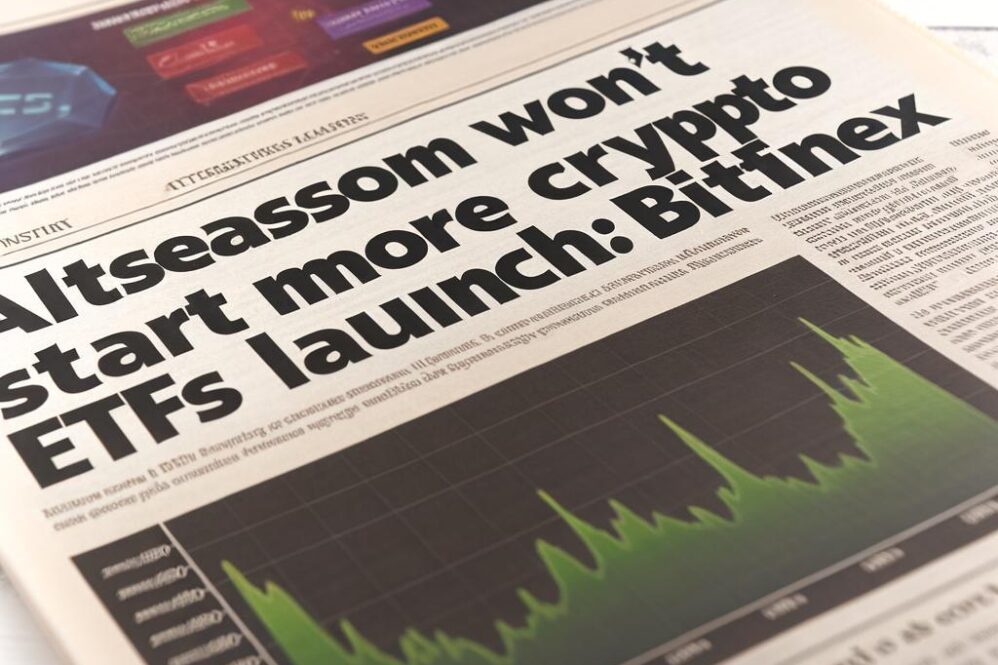
Bitfinex warned Thursday that a sustained rally in alternative cryptocurrencies – commonly dubbed “altseason” – is unlikely to materialize until a broader slate of crypto exchange-traded funds (etfs) receives approval and comes to market. In a note outlining the exchangeS market outlook, Bitfinex argued that wider ETF availability is necessary to unlock fresh institutional and retail flows into altcoins, reduce Bitcoin’s market dominance and create the structural liquidity conditions that typically precede broad-based altcoin advances.
The assessment frames ETF approvals as a potential inflection point for digital-asset allocation, placing regulatory timelines and product launches at the center of traders’ expectations as they monitor volatility, on-chain signals and macroeconomic drivers that could hasten – or delay – the next phase of the crypto cycle.
Altseason Delayed,Bitfinex Asserts: ETF Approvals Seen as prerequisite
Bitfinex analysts contend that a broad-based altcoin rally remains unlikely until clearer approval of spot Bitcoin exchange-traded funds materializes. the exchange’s research notes that institutional appetite for regulated, custody-friendly Bitcoin products has siphoned potential liquidity away from alternative tokens, and that markets are exhibiting a risk-off posture while awaiting regulatory signals. As long as uncertainty around ETF approvals persists, capital is expected to favor perceived safe-haven positions within crypto, most notably Bitcoin.
The exchange identifies several structural drivers that, in its view, make ETF approvals a practical prerequisite for altseason. Key factors cited include:
- Institutional inflows: large, regulated vehicles concentrate buying power into Bitcoin rather than smaller-cap altcoins.
- regulatory clarity: formal approvals reduce compliance risk for fund managers and custodians, encouraging allocative shifts toward approved products.
- Liquidity consolidation: depth in bitcoin markets absorbs new demand, limiting spillover into altcoin markets until redistribution occurs.
- Market signaling: approvals would serve as a confidence signal that could trigger secondary rotations into altcoins.
For market participants, Bitfinex recommends prudence and observational strategies while the approval process unfolds. Traders and investors are advised to monitor flows into spot BTC products, changes in bitcoin dominance, and on-chain custody trends as leading indicators of potential rotation. should approvals clear the path, the exchange anticipates a phased reallocation of capital that could set the stage for a subsequent altcoin advance, but stresses that timing and breadth of any such move will depend on the scale and velocity of institutional participation.
Bitfinex Executive Points to Institutional Inflows as Catalyst for Altcoin Rally
A senior Bitfinex executive told reporters that the recent uptick in alternative cryptocurrencies reflects a notable shift in market composition driven by renewed institutional interest. The executive pointed to a steady stream of capital moving away from pure Bitcoin allocation into selective altcoin exposures, facilitated by over‑the‑counter (OTC) desks, prime brokerage services, and on‑exchange liquidity provision. Institutional inflows, the executive said, are changing order‑book dynamics and concentrating buying pressure into higher‑beta tokens.
Market participants cited by the exchange highlight several structural changes that have lowered the barrier for large investors to participate in altcoins. those changes include improved custodial solutions, growing availability of regulated investment vehicles, and the maturation of decentralized finance primitives that offer staking and yield. The executive emphasized that these developments are enabling more predictable deployment of capital at scale.
- Search for yield: Institutions are allocating to tokens that provide staking rewards, lending yields, or revenue‑sharing mechanics.
- Product maturation: Enhanced custody, compliance, and prime services reduce operational and regulatory frictions.
- Portfolio diversification: Allocations to non‑Bitcoin assets are being used to achieve targeted factor exposures.
- Liquidity corridors: Improved OTC and exchange liquidity permits larger, less disruptive trades.
While the executive framed the inflows as a potential catalyst for sustained altcoin thankfulness, he also warned of attendant risks. The market is highly likely to experience periods of heightened volatility as capital rotates and correlations evolve,and exchanges must continue to bolster surveillance and compliance capabilities. Portfolio managers, the executive advised, should adopt disciplined risk management and transparency in execution as institutional participation deepens.
Market Mechanics: How New Crypto ETFs Could Shift Liquidity Toward Altcoins
The introduction of new crypto exchange-traded funds alters the plumbing of digital-asset markets by channeling organized capital into tradable,regulated vehicles. ETFs that include altcoin exposure or that track indices containing non-Bitcoin tokens create a predictable demand signal: fund managers must buy and hold the underlying assets to mirror their benchmarks. that mechanical demand can compress bid-ask spreads and deepen order books for selected altcoins, particularly where existing markets are thin and institutional counterparties step in to provide liquidity.
At the operational level, the creation/redemption process and the role of authorized participants shape how ETF flows translate into spot-market activity.When an ETF attracts inflows, authorized participants either deliver tokens to the fund or hedge in derivatives markets, prompting market makers to source inventory across exchanges. This arbitrage nexus – linking spot,futures and swap venues – can route liquidity toward altcoins through several channels:
- Direct purchases by fund custodians or managers to match index weights;
- Market-maker hedging that necessitates buying or selling underlying tokens;
- Derivative-driven spillovers as basis trades and funding-cost arbitrage move capital across instruments;
- Rebalancing flows when indices update constituent weights or when investors rotate between funds.
While these dynamics can improve price finding and attract a broader investor base,they also concentrate risk. ETFs can amplify volatility during stressed conditions as creation and redemption frictions, custody constraints and liquidity mismatches may force rapid deleveraging.Regulators and custodians will therefore influence which altcoins benefit most - larger-cap tokens with robust custody support and clear compliance profiles stand to gain first, while niche projects may remain sidelined despite headline inflows. Market participants should weigh the structural liquidity upgrades against the potential for correlated flows and sudden repricing when ETF strategies adjust or unwind.
Outlook and Timetable: What investors Should Expect from the ETF Approval Process
Investors should anticipate a multi-stage regulatory process in which a formal filing triggers a period of review, public comment and possible negotiation with regulators. At each stage the Securities and Exchange Commission may request additional disclosures or changes to trading and surveillance arrangements, and those exchanges between applicants and regulators can meaningfully extend the calendar from initial filing to final determination. as a result, expectations should be calibrated toward a measured timetable rather than a rapid, single-decision outcome.
Practical considerations for investors include monitoring regulatory filings and watching for specific signals that indicate progress or delay.Key items to track are:
- Submission updates – amendments to the filing or additional exhibits that respond to regulator questions.
- Public comments – formal comment letters or industry responses that reveal contentious legal or market-structure issues.
- regulatory correspondence – staff statements or orders that suggest conditional approvals or further examination.
Market participants should also prepare for heightened price sensitivity around milestone announcements. Approval, denial or even an unexpected extension can prompt sharp, short-term moves as algorithmic strategies and discretionary traders react. Institutional investors will likely adjust execution windows and custody plans in advance, while retail investors should be cautious about committing capital immediately following headline events because of potential volatility and liquidity shifts.
prudent portfolio management calls for scenario planning. Prepare for outcomes that include full approval, conditional approval with additional compliance requirements, outright denial or litigation-driven delays. maintaining allocation discipline, setting clear entry and exit rules, and staying informed of regulatory developments will help investors navigate the timetable and translate regulatory milestones into considered strategic choices.
As Bitfinex argues, the next broad-based rally for alternative cryptocurrencies is likely contingent on a fresh wave of institutional products that can redistribute liquidity away from bitcoin. Until regulators greenlight more crypto ETFs and issuers bring diverse,scalable products to market,capital flows may continue to favor BTC - keeping major altcoin moves constrained and episodic rather than systemic.
For market participants, the path to any sustained altseason will be measured by regulatory developments, ETF filings and approvals, shifts in bitcoin dominance, and the accompanying on‑chain and liquidity indicators that signal institutional participation. Investors should thus balance possibility with caution: monitor product launches and regulatory guidance closely, maintain disciplined risk management, and avoid extrapolating short‑term altcoin strength into an enduring market regime.
The dialog between regulators, exchanges and asset managers will shape the timing and character of the next major rotation. For investors and observers alike, staying attuned to ETF developments and institutional flows will be essential in assessing when – and if – a true altseason finally arrives. Stay with The Bitcoin Street Journal for continuing coverage and analysis as these events unfold.